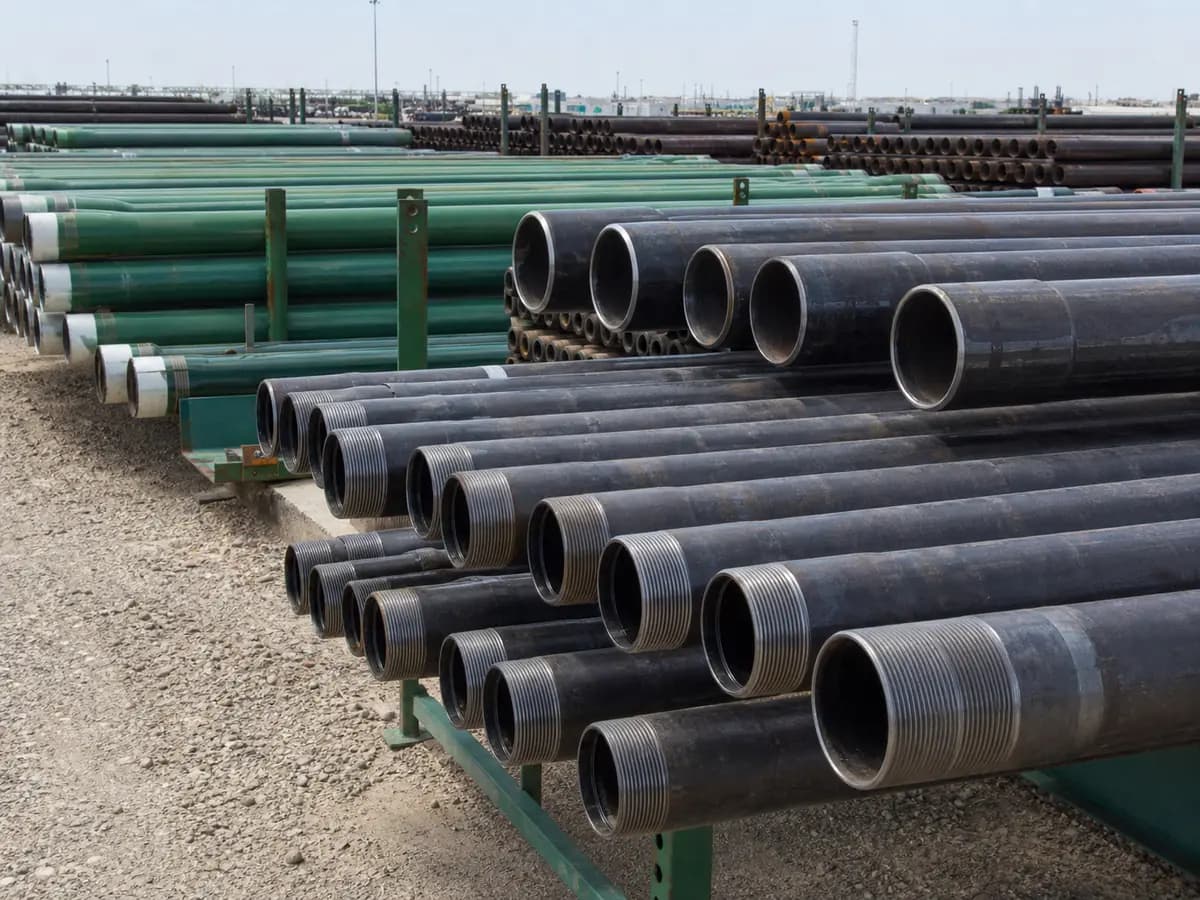
AI-generated category reference. It is not a photograph of a specific manufacturer or exact product model.
OCTG & Tubular Handling
OCTG Casing and Tubing
OCTG casing and tubing with the dimensions an RFQ needs: OD, nominal weight, wall, ID and drift. A 7 in casing example shows how weight changes ID and internal capacity at the same OD.
7 in casing: dimension example by nominal weight
Reference fields for quotation comparison. Final values must be confirmed in the signed manufacturer datasheet.
| OD and nominal weight | Wall / ID | API drift | Internal capacity | Buyer note |
|---|---|---|---|---|
| 7 in, 20 lb/ft | 0.272 in wall / 6.456 in ID | 6.331 in | 0.04049 bbl/ft | Lightest weight in this example |
| 7 in, 23 lb/ft | 0.317 in wall / 6.366 in ID | 6.241 in (6.250 in alternate drift) | 0.03937 bbl/ft | State standard or alternate drift on the RFQ |
| 7 in, 26 lb/ft | 0.362 in wall / 6.276 in ID | 6.151 in | 0.03826 bbl/ft | Worked example used in the capacity calculator |
| 7 in, 29 lb/ft | 0.408 in wall / 6.184 in ID | 6.059 in | 0.03715 bbl/ft | Heaviest weight in this example |
Calculators and selection guide
Use the ID in the published casing dimension row for the exact size and nominal weight. Pair that ID with the inner string OD for annular volume. Check drift, coupling clearance and connection fit separately.
Product overview
What this page covers
Casing and tubing are ordered by outside diameter and nominal weight per foot, not by inside diameter. At a fixed OD, a heavier nominal weight means a thicker wall and a smaller ID. The table above shows this for 7 in casing: moving from 20 lb/ft to 29 lb/ft reduces the ID from 6.456 in to 6.184 in and the internal capacity from 0.04049 to 0.03715 bbl/ft, about 8% less volume per foot at the same OD.
The dimensions are a reference example for checking an RFQ. Confirm the final values against the governing specification, API Spec 5CT for casing and tubing, and the mill datasheet for the pipe you buy.
How to use these dimensions
- Volume inside the string: use the nominal ID in the pipe capacity calculator. For 7 in 26 lb/ft casing, 6.276 in ID over 1,000 ft holds about 38.26 bbl.
- Volume outside an inner string: use the casing ID as the outer bore and the inner pipe OD in the annular capacity calculator.
- Clearance for tools and inner strings: use the drift, not the ID. Drift is the mandrel diameter that must pass through every joint. API standard drift for 4-1/2 in to 8-5/8 in casing is the nominal ID less 1/8 in. Some weights also have an alternate drift, so state which one you need.
Fields a casing or tubing RFQ must state
- OD and nominal weight per foot (this fixes the wall and ID)
- Grade, for example J55, L80 or P110 (this changes strength, not ID)
- Connection: API short or long round thread, buttress, or a named premium connection
- Range length and total footage or joint count
- Drift requirement: standard or alternate
- End finish, coupling type and any special-clearance couplings
- Coating, thread compound and protector requirements
- Mill test certificates, inspection level and third-party witness points
- Delivery destination, Incoterm and required date
What a reference table does not prove
A matching OD and weight does not prove that two connections make up, that a grade suits the well's sour-service or collapse loads, or that a pipe is in stock. Those points are closed during technical clarification with the mill or supplier before an order is released.
Technical reference trail
These public references support the equipment family and selection context. They do not imply dealership, authorization or a guaranteed order specification.
Frequently Asked Questions
Why does the same OD casing have different inside diameters?
Casing is specified by OD and nominal weight per foot. At a fixed OD, a higher weight means a thicker wall, so the ID is smaller. For 7 in casing, 23 lb/ft has a 6.366 in ID and 26 lb/ft has a 6.276 in ID. Always quote the weight, not only the OD.
Should I use the ID or the drift diameter?
Use the nominal ID for volume and capacity calculations. Use the drift when checking whether a tool, plug or inner string will pass, because drift is the guaranteed minimum clearance and is smaller than the ID.
Does the grade change the dimensions?
No. For the same OD and nominal weight, grades such as J55, L80 and P110 share the same wall and ID. Grade sets strength and service suitability, so it must still be stated on the RFQ.
What information is needed to quote OCTG casing and tubing?
OD, nominal weight, grade, connection, range length, quantity, drift requirement, end finish, coating, documentation and delivery terms. Upload the well's tubular schedule or specification sheet if you have one.
Submit RFQ for OCTG Casing and Tubing
Send product, quantity, specification and destination details so the requirements can be reviewed with potential suppliers.
Technical and RFQ References
Check common units, standards and purchasing terminology, then build a structured request for this equipment.
Related Products
Drill Pipe Configuration References
Compare two TSC drill-pipe configurations with NEW pipe-body dimensions, distinct heading-weight designations and connection-specific RFQ questions.
Tubing and Casing Couplings
Compare named tubing and casing coupling configurations using published OD, length and unit mass, while keeping thread identity, grade and inspection acceptance separate.
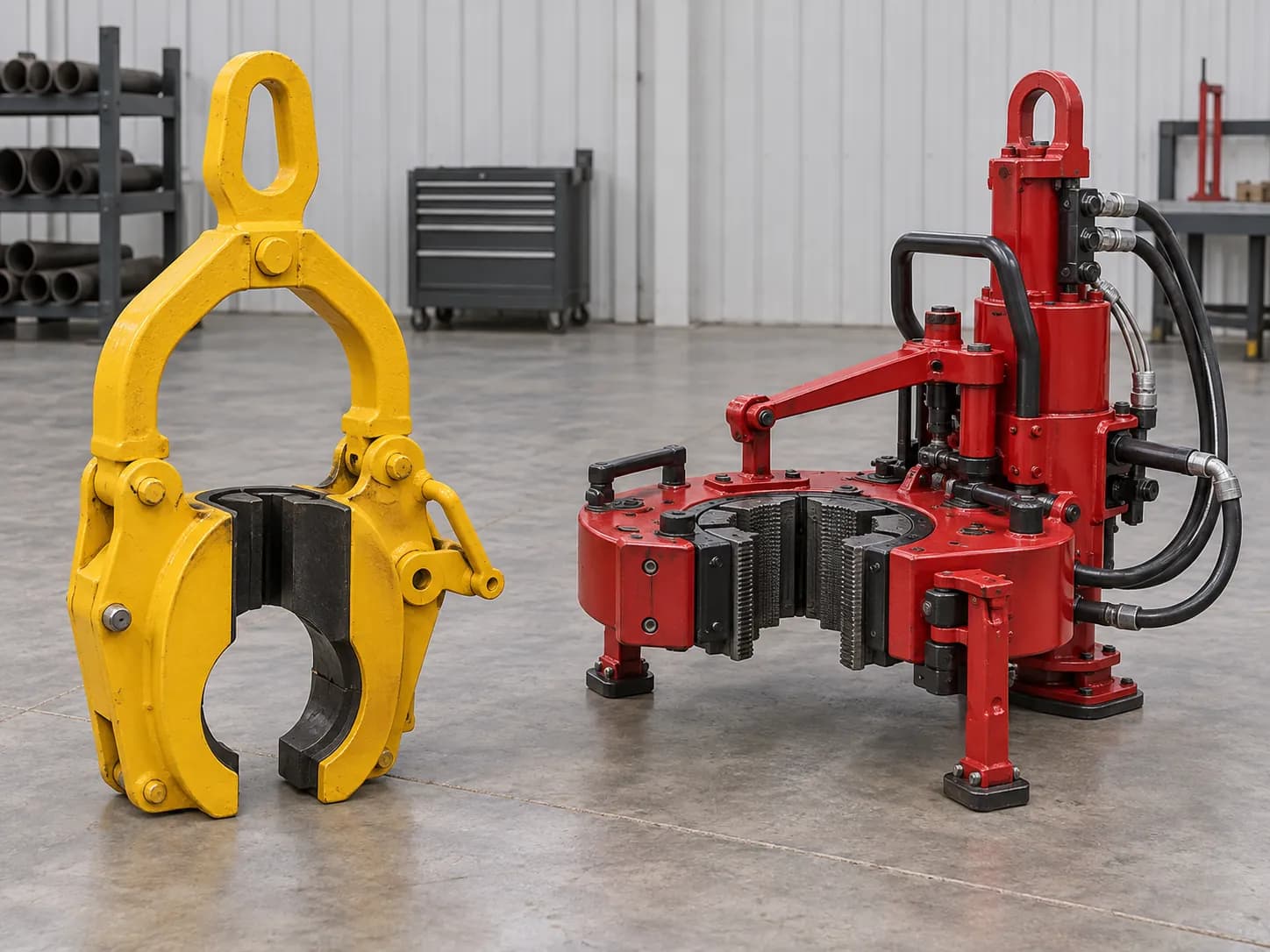
Tubular Handling Tools: Single-Joint Elevator References
Compare specific NOV SJH and D-SJX single-joint elevator rows without transferring load ratings, size intervals or compatibility claims between assemblies.
Related Technical Articles
Oilfield Equipment Supplier RFQ Guide
How buyers can compare oilfield equipment suppliers and prepare RFQs for wellhead equipment, drilling tools, pressure-control parts, and oilfield spares.
Casing Drift vs ID: Check Downhole Tool Clearance
Read casing body ID, standard drift and connection ID separately before approving a tool envelope. Compare two published 9-5/8 in connection tables.
Liner Hanger Selection: Running OD vs Installed Bore
Use a Halliburton case to distinguish maximum running OD, minimum passage ID, installed bore and the parent-casing qualification basis.