Selection & Specification
Pipe Capacity, Annular Volume and Displacement: Which OD or ID to Use
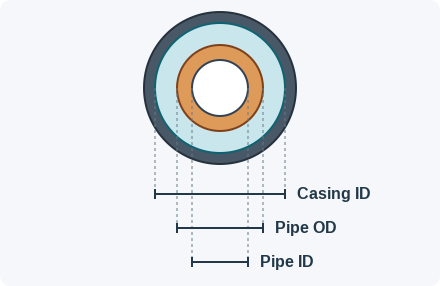
Four volumes, two diameters
Pick the space you are measuring before choosing a diameter. Fluid inside the inner pipe uses its ID; fluid outside the inner pipe uses its OD and the casing ID (or open-hole diameter). For displacement, choose whether the pipe bore can fill. The geometry below assumes a uniform, round section.
| Question | Volume | Formula, bbl/ft (diameters in inches) | Diameter it uses | Calculate |
|---|---|---|---|---|
| How much fluid is inside the pipe? | Internal capacity | ID² ÷ 1029.4 | Pipe ID | Internal capacity |
| How much fluid is between the pipe and the hole or casing? | Annular capacity | (D² − OD²) ÷ 1029.4 | Hole or casing ID, and pipe OD | Annular capacity |
| How much fluid does the steel wall push aside? | Metal (open-end) displacement | (OD² − ID²) ÷ 1029.4 | Pipe OD and ID | Open-end displacement |
| How much does the pipe push aside if the bore is closed or being pulled full? | Closed-end displacement | OD² ÷ 1029.4 | Pipe OD | Closed-end displacement |
The constant 1029.4 converts square inches to barrels per foot. It is the factor used on the IADC WellSharp field formula sheet, page 2.
Most calculation mistakes come from putting the wrong diameter into the right formula. Internal capacity never uses OD; annular capacity never uses the inner pipe's ID; and the outer diameter of an annulus inside casing is the casing ID, not the casing OD.
One worked example, all four volumes
For an illustrative uniform pipe-body calculation, take 10,000 ft of 5 in drill pipe with an assumed 4.276 in pipe-body ID, run inside 9-5/8 in 40 lb/ft casing. That casing has a 0.395 in wall and an 8.835 in ID in the API round-thread and buttress casing chart.
| Volume | Calculation | Per foot | Over 10,000 ft |
|---|---|---|---|
| Internal capacity of the drill pipe | 4.276² ÷ 1029.4 | 0.01776 bbl/ft | 177.6 bbl |
| Metal displacement | (5² − 4.276²) ÷ 1029.4 | 0.00652 bbl/ft | 65.2 bbl |
| Closed-end displacement | 5² ÷ 1029.4 | 0.02429 bbl/ft | 242.9 bbl |
| Annular capacity, casing to pipe | (8.835² − 5²) ÷ 1029.4 | 0.05154 bbl/ft | 515.4 bbl |
| Internal capacity of the casing | 8.835² ÷ 1029.4 | 0.07583 bbl/ft | 758.3 bbl |
Two checks prove the numbers are consistent. Internal capacity plus metal displacement equals closed-end displacement: 177.6 bbl and 65.2 bbl are individually rounded displays; adding the unrounded values and then rounding gives 242.9 bbl (adding the displayed values gives 242.8 bbl). Annular capacity plus closed-end displacement equals the casing's internal capacity: 515.4 + 242.9 = 758.3 bbl. If your own numbers do not add up this way, one of the diameters is wrong.
The values in bbl/ft are per unit length, not total volume. Multiply by section length in feet; for different casing IDs or pipe ODs, calculate each section and sum the unrounded volumes.
When to use open-end or closed-end displacement
Open-end (metal) displacement applies when the pipe is open at the bottom and fluid can enter the bore as it is run. Only the steel volume displaces fluid: 0.607 bbl for a 93 ft stand of the pipe above.
Closed-end displacement applies when fluid cannot enter the bore, for example with a float valve in the string or when pulling a wet string with the bore full. The whole OD envelope displaces fluid: 2.259 bbl for the same 93 ft stand, almost four times as much.
Which case applies is an operational decision for the trip sheet and the well-control plan. This guide only shows the arithmetic for each case; it does not choose one.
Where OD and ID come from
Pipe OD is the nominal outside diameter, such as 5 in drill pipe or 7 in casing.
Pipe ID is set by the OD and the nominal weight per foot together. The same OD comes in several weights, and each weight has its own wall and ID. For 9-5/8 in casing over 10,000 ft around 5 in pipe, the two chart rows give different annular volumes: 36 lb/ft: 8.921 in ID gives 530.3 bbl; 40 lb/ft: 8.835 in ID gives 515.4 bbl. Always take ID from the specification for the exact OD and weight, as listed on the OCTG casing and tubing page, not from the trade size.
Drill pipe ID usually means the pipe-body ID. The 4.276 in value above is a pipe-body ID, not a minimum pass-through bore or a drift guarantee. Tool joints have a smaller bore and a larger OD, so a detailed calculation treats them as separate short sections. The drill pipe configuration references list pipe-body dimensions separately from tool-joint data for that reason.
Drift is not ID. Drift is the diameter of a mandrel that must pass through every joint, and it is smaller than the nominal ID. For 9-5/8 in 40 lb/ft casing, API standard drift is the 8.835 in ID less 5/32 in, which is 8.679 in. An 8.750 in alternate drift is also listed for this weight, so an RFQ must say which drift it needs. Use ID for volumes and drift for clearance checks.
Common mistakes
- Using OD for internal capacity. For the 5 in pipe above, OD² ÷ 1029.4 gives 242.9 bbl instead of 177.6 bbl, which is the closed-end displacement, not the fluid inside.
- Using casing OD as the annulus outer diameter. The annulus is inside the casing, so the outer diameter is the casing ID.
- Mixing up open hole and cased hole. In open hole the outer diameter is the bit or caliper size, and washouts make the real volume larger. Cement volumes add an excess factor for that reason.
- Treating a tapered string as one section. Split the string wherever the OD or ID changes and add the sections.
RFQ checklist for tubular volume work
Send these with your RFQ so the supplier quotes pipe that matches your calculations:
- OD and nominal weight per foot for each string (these fix the ID)
- Grade and exact connection; verify pipe-body ID separately from the connection or tool-joint bore
- Drift requirement: standard or alternate
- Section lengths for tapered strings
- Tool-joint OD and ID for drill pipe, if you calculate trip volumes
- The calculation or schedule the volumes came from, so the supplier can check it against their pipe data
Build an RFQ for tubulars once the string is defined.