Selection & Specification
Mud Hopper Nozzle, Package and Feed Selection
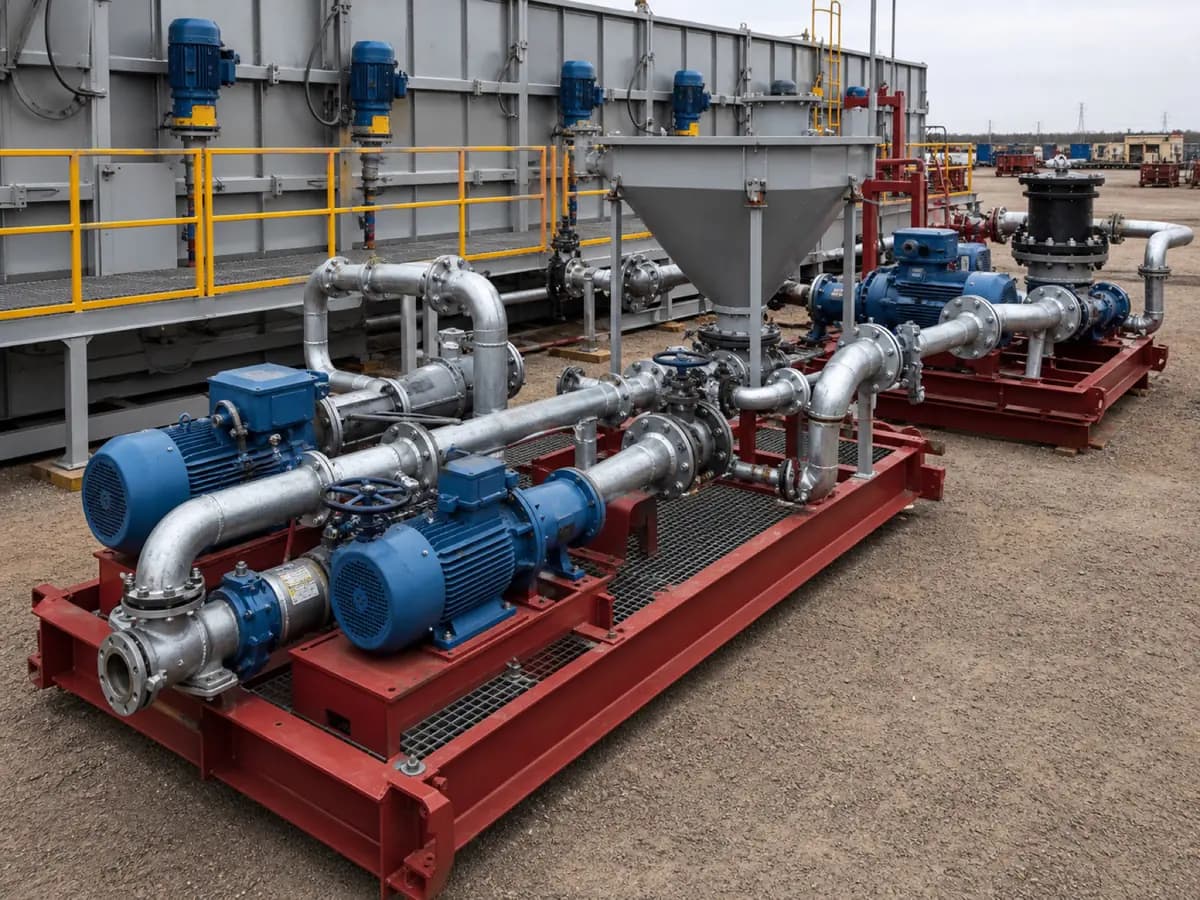
View the model-specific values, conditions and sources
Begin with the missing link, not the largest flow number
A hopper enquiry often contains two numbers that describe different things: a circulating liquid flow and a desired powder addition rate. The first does not prove the second. A useful selection review connects the additive, the hydraulic circuit and the supplied package before ranking offers by price or catalogue capacity.
Consider a fictional comparison. One bidder offers a replacement hopper for an existing pump circuit; another includes a new pump and skid but excludes the electrical cabinet. Both describe their offer as a mud mixer. Their prices and performance statements are not comparable until the buyer resolves those different boundaries.
Read the nozzle entry as a component clue
The GN Solids Control catalogue, printed page 40, gives GNSLDSC a 40-mm nozzle entry, 174-kg weight and 1100 x 680 x 949-mm dimension triplet in its bare Mud Hopper table. Those entries identify a particular catalogue configuration; they are not a tested powder-induction curve.
A nozzle bore matters to the hydraulic review, but this source labels the column simply Nozzle. It does not supply the measurement datum, tolerance or insert drawing needed to order a replacement by size alone. Ask the supplier to identify the nozzle part, geometry basis, material and compatible body. Do not treat a similar model name or shared nominal pipe size as proof of fit.
The retrieved PDF uses C-suffix models. Keep that identity on the drawing register and quotation schedule. A B-suffix reference from an earlier catalogue requires its own review; matching headline values cannot establish an unchanged design.
Define what the flow evidence actually measures
The current GN page presents liquid-capacity and pressure entries separately from nozzle dimensions. It labels the parameters reference-only. Before using those entries in a comparison, ask what fluid and circuit conditions support the offered performance.
Distinguish available flow at the hopper supply connection from an isolated pump's catalogue capacity. Submit the intended circuit schematic, elevation information, line configuration and return boundary for the responsible supplier's assessment. Request a duty-specific explanation of the pump selection and the effects of the proposed piping arrangement. Do not turn a catalogue pressure band into a site operating setting.
Then make the dry-additive requirement independently measurable. State the actual additive identity, physical form, bulk-density basis, packaging and required addition schedule. Specify what would count as acceptable incorporation or wetting for the project. A liquid volume rate, powder mass rate and completed batch time are different acceptance measures, not alternative units for one capacity.
GN Solids Australia's description supports the qualitative purpose of adding solids to liquid. It does not provide a verified dry-feed rate or prove that every formulation reaches the required final properties. Ask bidders to disclose the test basis and exceptions rather than supplying a conversion factor that the source never established.
Draw the purchase boundary around the circuit
Split the equipment schedule into hopper assembly, pump and driver, piping and valves, supporting skid, instruments and controls. Mark existing equipment separately from new supply. For a replacement, an interface drawing should identify the retained connections and mounting points; the hopper's overall dimension triplet cannot replace that drawing.
The GN page describes a unit including a pump, hopper, base and pipe valves, while providing a separate hopper table. Its cabinet remark says that the electrical cabinet is quoted separately and excluded from the unit-table mass and dimensions. This is a procurement boundary to resolve, not an invitation to assume a complete electrical system from a product photograph.
Return to the fictional bids. Ask the bare-hopper bidder who validates the retained pump circuit. Ask the package bidder who supplies the cabinet, field interfaces and final assembled envelope. Compare only the resulting documented scopes; an omitted cabinet is neither automatically a saving nor evidence that another bidder is overpriced.
Treat powder exposure as a design input
Bag opening, powder release and handling arrangements deserve an explicit project assessment. Request the proposed containment or extraction provisions, access requirements and responsibility boundaries. An open funnel illustration cannot demonstrate exposure control. Have the responsible project specialists establish the applicable requirements from the actual additive information and site conditions.
Similarly, require the offered driver and control configuration to be reviewed against the project's electrical and hazardous-area requirements. Neither the family label nor a general catalogue notation establishes certification of the purchased assembly. This guide concerns evidence and selection, not installation, valve sequencing, powder-handling procedures or operating instructions.
Release an evidence-backed comparison
Keep the selected model, suffix, nozzle identity, circuit review and package exceptions together as one decision record. Add shipping gross dimensions and mass separately from component reference values. This helps an export purchase remain traceable without turning catalogue figures into transport approvals.
Use the Mud Mixing Hoppers product reference for the retained configuration. Submit the unresolved duty and scope questions through the RFQ Builder, then require a consistent acceptance basis before commercial comparison.
Referenced model data
- GNSLDSCCatalogue nozzle size (source: Nozzle)
- 40 mm
Only the bare Mud Hopper GNSLDSC row on the retrieved C-suffix catalogue page. The same row gives 174 kg and 1100 x 680 x 949 mm. Nozzle is the source heading; a bore measurement datum, tolerance, insert drawing, wear limit and nozzle part number are not defined. Do not treat this as a certified fit diameter, dry-solids feed rate or a GNSLH complete-unit specification. The current official HTML corroborates this size but calls its parameters reference-only.
Printed p.40 (PDF p.40), 4.5 Jet Mud Mixer, upper Mud Hopper table, GNSLDSC row, Nozzle columnRevision No printed revision adopted; retrieved file contains C-suffix models on printed page 40 · Checked 2026-10-24
- GNSLDSCCatalogue bare-hopper mass (source: Weight)
- 174 kg
Same explicit GNSLDSC bare Mud Hopper row as the 40-mm nozzle entry. Weight in kg is retained as catalogue component mass, not force, skid-package mass, packed gross mass or lifting-design approval. No mass tolerance or packing basis is stated. Do not merge the 1675-kg GNSLH-550C package row or any historical B-suffix record into this model.
Printed p.40 (PDF p.40), upper Mud Hopper table, GNSLDSC row, Weight columnRevision No printed revision adopted; retrieved file contains C-suffix models on printed page 40 · Checked 2026-10-24
- GNSLDSCCatalogue dimension triplet
- 1100 x 680 x 949 mm
Same GNSLDSC bare Mud Hopper row as nozzle 40 mm and mass 174 kg. PDF heading is printed Dimensiom; current official HTML labels the matching triplet L x W x H. Not a certified installation envelope, foundation drawing, access clearance or packed shipping size; no tolerance or datum scheme is supplied.
Printed p.40 (PDF p.40), upper Mud Hopper table, GNSLDSC row, rightmost Dimensiom columnRevision No printed revision adopted; retrieved file contains C-suffix models on printed page 40 · Checked 2026-10-24
- GN GNSL jet mud mixing unit familyFamily catalogue referenceJet mixing unit component boundary
- The unit description includes a sand pump, mixing hopper, base and pipe valves; the page provides a separate bare-hopper table.
Family description only. The source paragraph contains repetitive hopper wording and is not a controlled bill of materials; no exact hopper count or model pairing is inferred. The complete-unit GNSLH table and the bare-hopper GNSLDS table must not be merged. Not a guaranteed supply scope for an offered configuration.
DESCRIPTION paragraph before GNSL Jet Mud Mixing Hopper Unit; compare the two Technical Parameters table headingsChecked 2026-10-24
- GN GNSL jet mud mixing unit familyFamily catalogue referenceControl cabinet excluded from unit table mass and dimensions
- Electric control cabinet is separately quoted and excluded from the tabulated weight and dimensions.
Remark directly below the GNSL Jet mud Mixing Hopper Unit Technical Parameters table. Applies to the displayed unit-table basis, not a promise that every project offer excludes a cabinet. The table says parameters are for reference only. No hazardous-area approval, certificate scope or cabinet specification is established.
GNSL Jet mud Mixing Hopper Unit Technical Parameters table, Remarks row after GNSLH-110CChecked 2026-10-24
- GN mud mixing hopper familyFamily catalogue referenceHopper family additive-mixing purpose
- The description identifies mixing solid additives into liquid for drilling-fluid preparation.
Qualitative family purpose only. No numerical dry-solids feed capacity, wetting completeness, batch time, achieved mud properties, dust containment or product-specific performance guarantee is established. The separate table Capacity column is not adopted as a dry-solids mass rate.
Description opening paragraph before GNSL Jet mud Mixing Hopper Unit Technical ParametersChecked 2026-10-24
| Model | Parameter | Reference value | Conditions and source |
|---|---|---|---|
| GNSLDSC | Catalogue nozzle size (source: Nozzle) | 40 mm | Only the bare Mud Hopper GNSLDSC row on the retrieved C-suffix catalogue page. The same row gives 174 kg and 1100 x 680 x 949 mm. Nozzle is the source heading; a bore measurement datum, tolerance, insert drawing, wear limit and nozzle part number are not defined. Do not treat this as a certified fit diameter, dry-solids feed rate or a GNSLH complete-unit specification. The current official HTML corroborates this size but calls its parameters reference-only. Printed p.40 (PDF p.40), 4.5 Jet Mud Mixer, upper Mud Hopper table, GNSLDSC row, Nozzle columnRevision No printed revision adopted; retrieved file contains C-suffix models on printed page 40 · Checked 2026-10-24 |
| GNSLDSC | Catalogue bare-hopper mass (source: Weight) | 174 kg | Same explicit GNSLDSC bare Mud Hopper row as the 40-mm nozzle entry. Weight in kg is retained as catalogue component mass, not force, skid-package mass, packed gross mass or lifting-design approval. No mass tolerance or packing basis is stated. Do not merge the 1675-kg GNSLH-550C package row or any historical B-suffix record into this model. Printed p.40 (PDF p.40), upper Mud Hopper table, GNSLDSC row, Weight columnRevision No printed revision adopted; retrieved file contains C-suffix models on printed page 40 · Checked 2026-10-24 |
| GNSLDSC | Catalogue dimension triplet | 1100 x 680 x 949 mm | Same GNSLDSC bare Mud Hopper row as nozzle 40 mm and mass 174 kg. PDF heading is printed Dimensiom; current official HTML labels the matching triplet L x W x H. Not a certified installation envelope, foundation drawing, access clearance or packed shipping size; no tolerance or datum scheme is supplied. Printed p.40 (PDF p.40), upper Mud Hopper table, GNSLDSC row, rightmost Dimensiom columnRevision No printed revision adopted; retrieved file contains C-suffix models on printed page 40 · Checked 2026-10-24 |
| GN GNSL jet mud mixing unit familyFamily catalogue reference | Jet mixing unit component boundary | The unit description includes a sand pump, mixing hopper, base and pipe valves; the page provides a separate bare-hopper table. | Family description only. The source paragraph contains repetitive hopper wording and is not a controlled bill of materials; no exact hopper count or model pairing is inferred. The complete-unit GNSLH table and the bare-hopper GNSLDS table must not be merged. Not a guaranteed supply scope for an offered configuration. DESCRIPTION paragraph before GNSL Jet Mud Mixing Hopper Unit; compare the two Technical Parameters table headingsChecked 2026-10-24 |
| GN GNSL jet mud mixing unit familyFamily catalogue reference | Control cabinet excluded from unit table mass and dimensions | Electric control cabinet is separately quoted and excluded from the tabulated weight and dimensions. | Remark directly below the GNSL Jet mud Mixing Hopper Unit Technical Parameters table. Applies to the displayed unit-table basis, not a promise that every project offer excludes a cabinet. The table says parameters are for reference only. No hazardous-area approval, certificate scope or cabinet specification is established. GNSL Jet mud Mixing Hopper Unit Technical Parameters table, Remarks row after GNSLH-110CChecked 2026-10-24 |
| GN mud mixing hopper familyFamily catalogue reference | Hopper family additive-mixing purpose | The description identifies mixing solid additives into liquid for drilling-fluid preparation. | Qualitative family purpose only. No numerical dry-solids feed capacity, wetting completeness, batch time, achieved mud properties, dust containment or product-specific performance guarantee is established. The separate table Capacity column is not adopted as a dry-solids mass rate. Description opening paragraph before GNSL Jet mud Mixing Hopper Unit Technical ParametersChecked 2026-10-24 |
Authoritative references
- GN Solids Control equipment catalogue, printed page 40: C-suffix Mud Hopper and Jet Mud Mixer tableschecked 2026-10-24
- GN Solids Control Mud Mixing Hopper Unit: separate package and hopper tables, options and cabinet exclusionchecked 2026-10-24
- GN Solids Australia Mud Mixing Hopper: additive-mixing description and C-suffix tableschecked 2026-10-24