Selection & Specification
Single-Joint Elevators: SJH and D-SJX Row-Specific Selection
View the model-specific values, conditions and sources
Separate four questions before comparing elevators
A single-joint elevator enquiry should resolve model identity, tubular fit, stated rating and the boundary of the offered assembly as separate questions. A familiar product name cannot answer all four. Nor can a larger catalogue load number cure an unidentified jaw configuration.
This guide organizes a purchasing document review. It does not specify a lifting arrangement, a rigging method or an operating procedure. The responsible qualified reviewer and equipment manufacturer must address the intended application using the documents for the actual assembly.
Use a named row, not a merged family range
The NOV Manual Single Joint Elevators sheet lists the first SJH tubing-and-drill-pipe row at 5 short tons for 2-3/8 to 4-1/2 in tubular sizes. The D-SJX Heavy Duty table separately lists 12 short tons and 3-1/2 to 7-1/2 in.
Keep each size interval beside its model and row. Neither is a whole-string lifting rating. A catalogue interval also does not identify the jaw or insert supplied with an individual offer. These references provide a concrete starting identity, not acceptance of a complete handling system.
A document matrix with four closure points
Use the following matrix to prevent an answered dimension question from hiding an unanswered application question.
| Closure point | Buyer information to identify | Supplier document response | Reason to keep the item open |
|---|---|---|---|
| Model and row | Exact catalogue reference requested | Offered model, revision and configuration identity | Only a broad family name is returned |
| Tubular fit | Relevant body, upset or coupling geometry | Matched jaw or insert configuration and its reference | Only a broad nominal size interval is supplied |
| Stated rating | Intended duty and required review responsibility | Model-specific rating in its original unit | A value from another model or an unexplained unit appears |
| Assembly boundary | Complete equipment or identified replacement parts | Included components, exclusions and applicable drawing | Accessories are assumed to be common across models |
Give each unanswered field an owner and a required response. Do not collapse all four closure points into a single supplier compliance tick. A response can be internally consistent yet still lack the information needed for the intended duty.
Handle document conflicts without repairing them
Manufacturer sheets can contain several model columns and a mixture of narrative descriptions and table rows. When a response cites a broad narrative range but names a narrower row, ask which configuration is actually being offered. Do not combine the broadest endpoints from different places into a new range.
Likewise, keep short tons distinct from metric tonnes. If two representations disagree, retain the original documents and request clarification against the named row. An unmarked conversion or silently corrected number makes it harder for the next reviewer to identify what the manufacturer actually stated.
For these references, the selected load unit is short ton. No conclusion about certification, inspection acceptance or complete-system capacity follows from the model designation. Those questions need their own applicable documents and review.
Fictional desk review: a rating attached to the wrong identity
Consider a fictional offer headed SJH that attaches a D-SJX load value. Its size statement is copied from another catalogue column, and the quotation describes the included parts only as “standard jaws.”
This is not an offer that the buyer should repair by selecting a conservative number. The model, range and component identity are unresolved together. Request a corrected offer with one identified assembly, one supporting row and a specific jaw or insert reference. Keep the conflicting version available alongside the response.
A second fictional offer might return a coherent SJH row but omit the intended-duty confirmation. That offer has a different gap: its identity is clearer, but the application review remains open. Recognizing the difference allows a targeted question instead of sending the same generic checklist to every bidder.
Keep other handling equipment on separate lines
If the project also needs slips or power tongs, create separate technical lines for those items. An elevator's rating does not establish a slip capacity or a tong torque, and a shared tubular diameter does not prove cross-component compatibility. Replacement parts likewise need the installed assembly identity and applicable part reference.
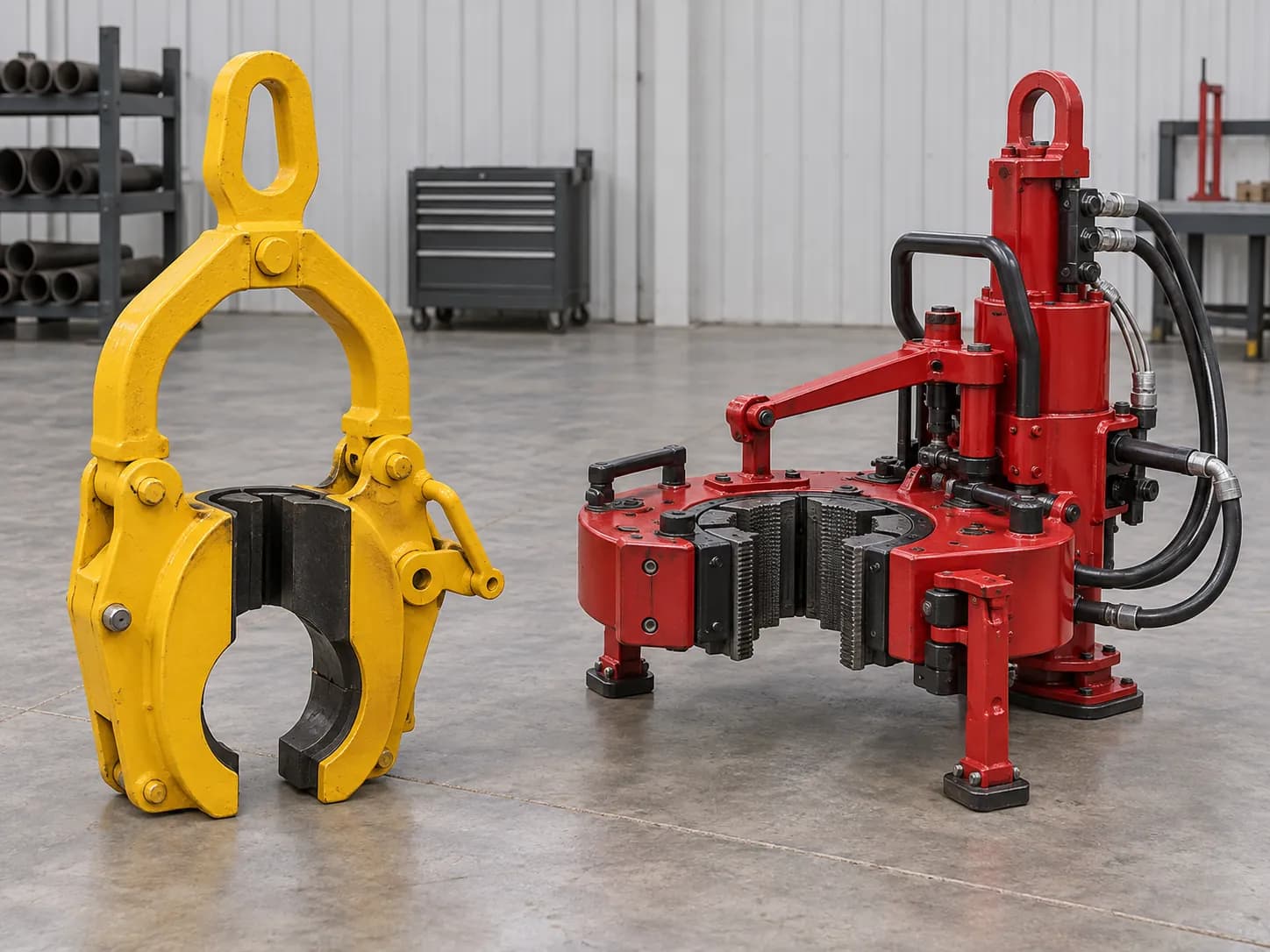
Use the tubular handling reference to preserve the selected rows, then submit the unresolved matrix through the handling-equipment RFQ Builder. Request quantity, included components, document scope and explicit deviations. The image is an AI-generated category illustration, not a verified SJH or D-SJX photograph. No catalogue reference here establishes current stock or manufacturer authorization.
Referenced model data
| Model | Parameter | Reference value | Conditions and source |
|---|---|---|---|
| NOV SJH / 2-3/8 to 4-1/2 in tubing and drill-pipe row | Listed elevator rated load | 5 short ton | NOV SJH / 2-3/8 to 4-1/2 in tubing and drill-pipe row; only this printed row is referenced. Load unit is short ton, not metric tonne. Single-joint equipment reference, never a whole-string lifting rating or acceptance of the complete lifting system. Exact jaw/insert configuration and intended duty require manufacturer confirmation. The first SJH tubing-and-drill-pipe row is used, not the other SJH size rows. Page 1, SJH leftmost table, first rowRevision RigDoc 97077894 Rev. 1 · Checked 2026-10-23 |
| NOV SJH / 2-3/8 to 4-1/2 in tubing and drill-pipe row | Listed tubular size range | 2-3/8 to 4-1/2 in | NOV SJH / 2-3/8 to 4-1/2 in tubing and drill-pipe row; only this printed row is referenced. Load unit is short ton, not metric tonne. Single-joint equipment reference, never a whole-string lifting rating or acceptance of the complete lifting system. Exact jaw/insert configuration and intended duty require manufacturer confirmation. The first SJH tubing-and-drill-pipe row is used, not the other SJH size rows. Page 1, SJH leftmost table, first row, Size columnRevision RigDoc 97077894 Rev. 1 · Checked 2026-10-23 |
| NOV D-SJX Heavy Duty / 3-1/2 to 7-1/2 in row | Listed elevator rated load | 12 short ton | NOV D-SJX Heavy Duty / 3-1/2 to 7-1/2 in row; only this printed row is referenced. Load unit is short ton, not metric tonne. Single-joint equipment reference, never a whole-string lifting rating or acceptance of the complete lifting system. Exact jaw/insert configuration and intended duty require manufacturer confirmation. Metric load figures differ between prose and table and are deliberately not reconciled. Page 1, D-SJX Heavy Duty table, 3-1/2 to 7-1/2 in rowRevision RigDoc 97077894 Rev. 1 · Checked 2026-10-23 |
| NOV D-SJX Heavy Duty / 3-1/2 to 7-1/2 in row | Listed tubular size range | 3-1/2 to 7-1/2 in | NOV D-SJX Heavy Duty / 3-1/2 to 7-1/2 in row; only this printed row is referenced. Load unit is short ton, not metric tonne. Single-joint equipment reference, never a whole-string lifting rating or acceptance of the complete lifting system. Exact jaw/insert configuration and intended duty require manufacturer confirmation. Metric load figures differ between prose and table and are deliberately not reconciled. Page 1, D-SJX Heavy Duty table, Size columnRevision RigDoc 97077894 Rev. 1 · Checked 2026-10-23 |
Authoritative references
- NOV Manual Single Joint Elevatorschecked 2026-10-23