Standards & Inspection
KF-73 Selection: Dissolution Tests Are Not Tool Qualification
View the model-specific values, conditions and sources
Separate three different buying decisions
A dissolvable magnesium offer can describe a material grade, a tested sample or a finished component. These are not alternative names for the same evidence. The buyer needs to know which decision each document supports before using it to compare quotations.
Treat the purchase as three linked levels: material identity, batch and test definition, then component qualification. A useful answer at the first level does not automatically answer the next. This distinction is especially important when a supplier offers both machining stock and finished parts, because a single commercial line can conceal several technical responsibilities.
Read the KF-73 reference with its conditions
The Meifu KF-73 table lists room-temperature minimum tensile strength of 310 MPa, yield strength of 220 MPa and elongation of 5%. It also lists a dissolution rate of 40–70 mg/(cm2*h) at 93 degrees C in a solution described as 3% KCl.
The page does not provide the mechanical specimen direction, heat-treatment condition, method or elongation gauge length. The dissolution entry leaves the concentration basis, flow condition, specimen-area method and duration unspecified. Those omissions are reasons to request a comparable test definition, not permission to choose convenient assumptions. An area-based mass-loss entry is not a complete-part clearance time.
Use a three-level comparison sheet
| Decision level | What the catalogue can contribute | What to request for the offer | Conclusion to avoid |
|---|---|---|---|
| Material identity | Named grade and attributed property references | Grade assignment, composition basis and processing condition | Every stock geometry is automatically that grade |
| Batch and test definition | Starting questions for mechanical and dissolution testing | Batch identity, specimen definition, method and reported conditions | Matching headline values prove comparable tests |
| Finished component | Context for choosing material questions | Part drawing, manufacturing scope and qualification responsibilities | Material strength establishes a tool pressure rating |
Keep separate acceptance fields for mechanical properties and dissolution behaviour. They describe different tests and need their own conditions. Do not combine a room-temperature mechanical minimum with a dissolution-test temperature to create an unstated high-temperature strength claim.
Make a missing test basis visible
Consider a fictional document comparison. Supplier A returns the catalogue dissolution range beside a proposed stock grade. Supplier B provides a test report but leaves the solution concentration basis and specimen-area definition unclear. The two documents cannot yet support a like-for-like dissolution comparison.
For A, request the batch-linked test documentation required by the order. For B, request the missing method details and their connection to the offered material. Do not average the catalogue endpoints, infer a part-removal time or rank the offers simply because one supplies more decimal places.
A practical review sheet can mark each condition as stated, not stated or different from the requested basis. Add a reference to the exact document location. This records the comparison honestly without inventing a correction factor for an undefined test.
Do not merge the stock menu with the grade table
The separate Meifu hollow-stock page gives inner-diameter and outer-diameter menus and a length entry, but does not assign that complete menu specifically to KF-73. Consequently, a buyer should request one actual dimensional combination and its grade assignment, not assume that all independently listed endpoints can be paired.
Put inner diameter, outer diameter, length, tolerances and machining allowance on the stock line. Put the finished-part drawing and machining responsibility on a separate line where machining is requested. Ask which material condition accompanies each line. A photograph cannot settle the grade, processing condition or dimensional availability.
This separation also makes alternatives easier to evaluate. A proposed change in geometry is not merely a new price for the same item; it changes the material or machining scope that must be reviewed.
Close the purchase without overstating the result
Before accepting an offer, check that the material identity, batch records and requested tests refer to the same supplied stock. Then identify who is responsible for the finished component's qualification. A stock certificate does not, by itself, establish a setting-load limit, a pressure rating or field-clearance behaviour.
Use the dissolvable magnesium stock reference and the RFQ Builder to send the grade, actual geometry, test-definition questions and separate machining scope. State the documents required for acceptance rather than asking only for “dissolvable material.”
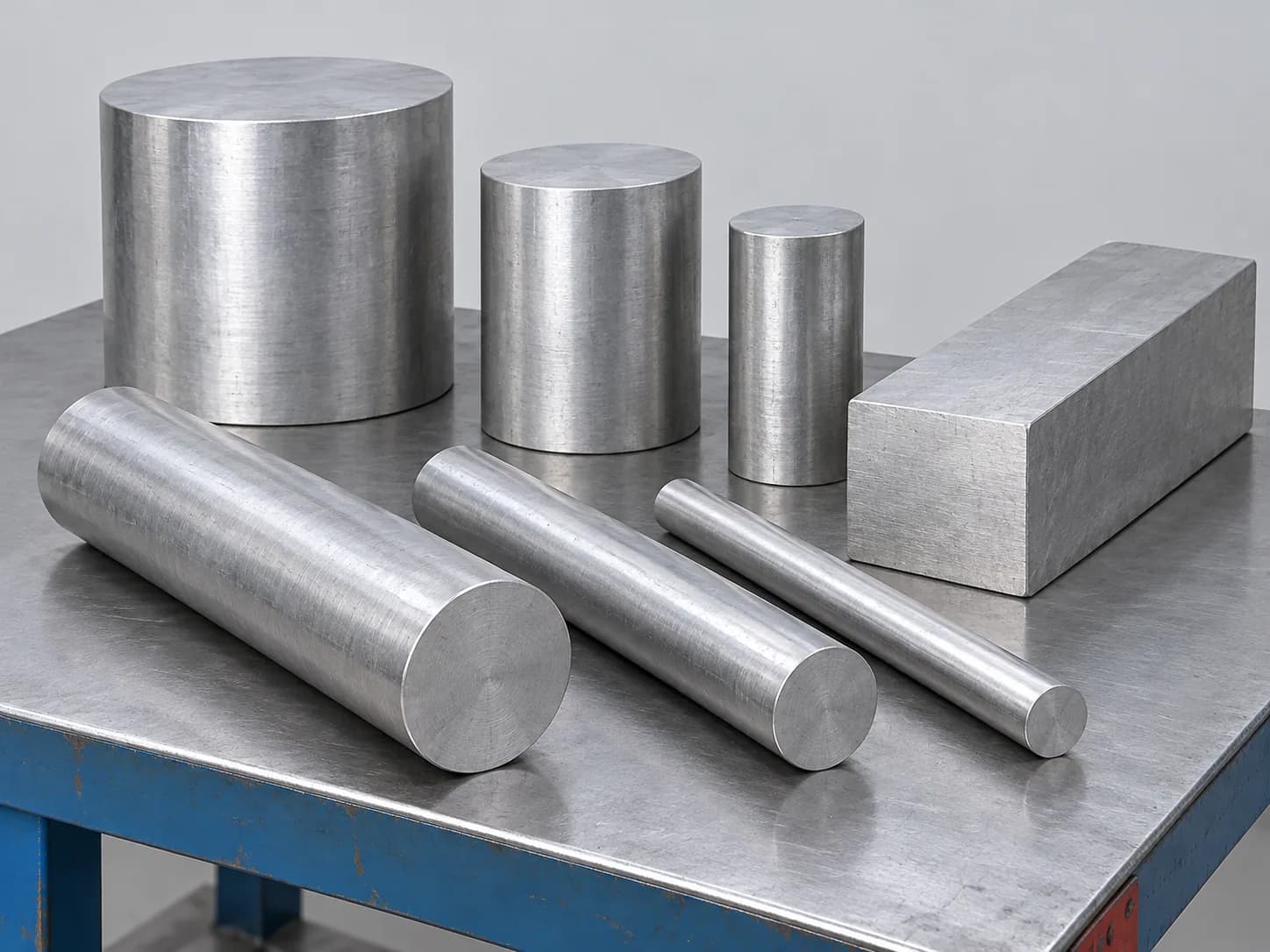
The AI-generated stock illustration does not verify magnesium composition, KF-73 identity or dissolution behaviour. Published material examples are not evidence of inventory or approval of an assembled completion tool.
Referenced model data
| Model | Parameter | Reference value | Conditions and source |
|---|---|---|---|
| KF-73 | minimum tensile strength room temperature | >= 310 MPa | Minimum tensile strength in the Mechanical Properties at Room Temperature table. Specimen direction, heat treatment, test method and the exact room-temperature definition are not supplied. Not strength at downhole temperature. Grade table / KF-73 / Min. Tensile Strength (MPa)Revision Web page has no controlled revision identified; retrieval time is not the issue date. · Checked 2026-10-23 |
| KF-73 | minimum yield strength room temperature | >= 220 MPa | Minimum yield strength in the same grade row. Offset definition, specimen direction and test method are not supplied; this is not a finished-component pressure rating. Grade table / KF-73 / Min. Yield Strength (MPa)Revision Web page has no controlled revision identified; retrieval time is not the issue date. · Checked 2026-10-23 |
| KF-73 | minimum elongation room temperature | >= 5 % | Minimum elongation in the same grade row. Gauge length, specimen direction and test standard are not supplied. Grade table / KF-73 / Min. Elongation (%)Revision Web page has no controlled revision identified; retrieval time is not the issue date. · Checked 2026-10-23 |
| KF-73 | listed dissolution rate | 40 to 70 mg/(cm2*h) | The grade row states test conditions of 93 degrees C and 3% KCL, using the manufacturer spelling. The mass/volume concentration basis, static/flowing condition, area method, specimen and duration are not specified. Do not convert this rate into complete-part clearance time. Grade table / KF-73 / Test Conditions and Dissolution RateRevision Web page has no controlled revision identified; retrieval time is not the issue date. · Checked 2026-10-23 |
| Meifu dissolvable hollow bar; grade unspecifiedFamily catalogue reference | hollow stock inner diameter menu | 35 to 80 mm | Hollow-bar catalogue dimensional menu, not a KF-73-specific supply range or a guarantee of every inner/outer-diameter combination. Hollow Bar (Dissolvable Magnesium Alloys) / IdRevision Web page has no controlled revision identified; retrieval time is not the issue date. · Checked 2026-10-23 |
| Meifu dissolvable hollow bar; grade unspecifiedFamily catalogue reference | hollow stock outer diameter menu | 50 to 180 mm | Separate hollow-bar catalogue reference. Actual wall thickness, tolerances, straightness and grade assignment require quotation confirmation. Hollow Bar (Dissolvable Magnesium Alloys) / OdRevision Web page has no controlled revision identified; retrieval time is not the issue date. · Checked 2026-10-23 |
| Meifu dissolvable hollow bar; grade unspecifiedFamily catalogue reference | hollow stock listed length | 1000 mm | Catalogue length entry, not a finished-part length or tolerance and not proof that every KF-73 size is in stock. Hollow Bar (Dissolvable Magnesium Alloys) / LengthRevision Web page has no controlled revision identified; retrieval time is not the issue date. · Checked 2026-10-23 |
Authoritative references
- Dissolvable Magnesium Alloys OEM-KF73 | Meifuchecked 2026-10-23
- Dissolvable Magnesium Alloy Hollow Rod Manufacturerchecked 2026-10-23