Instrumentation & Automation
Temperature Transmitters, Thermocouples and RTDs
Compare temperature instruments using published FDWB integrated and compact transmitter examples. Specify the sensor type, calibrated span, probe construction and control-system input separately.
Manufacturer-published temperature references
Reference fields for quotation comparison. Final values must be confirmed in the signed manufacturer datasheet.
| Variant / parameter | Published reference | Scope / selection limit |
|---|---|---|
| FDWB integrated / resistance-sensor range | -200 to 600 degrees C | Published range for the resistance-sensor configuration, not for every FDWB variant. |
| FDWB integrated / thermocouple range | 0 to 1700 degrees C | Published thermocouple configuration range; select the sensor designation for the duty. |
| FDWB integrated / accuracy options | 0.25% FS; 0.5% FS; 1.0% FS | The source makes accuracy dependent on sensor designation and measuring range; FS means full scale. |
| FDWB compact / measurement range | -50 to 150 degrees C | Compact-version reference; do not apply the integrated transmitter's wider intervals. |
| FDWB compact / supply | 16 to 28 volts DC | The manufacturer recommends 24 volts DC. |
| FDWB compact / accuracy options | 0.25% FS; 0.5% FS | Select the required full-scale accuracy in the quotation. |
Product overview
Temperature measurement, with variant-specific limits
Temperature instruments should be compared by sensing element and transmitter configuration, not by the FDWB family name alone. This sourcing page uses FRD CONTROL examples to make that distinction explicit; it is not an offer of every listed variant or a claim of manufacturer authorization.
The FDWB integrated transmitter page separates resistance-sensor and thermocouple measurement ranges. It describes temperature measurement in liquids, gases and on solid surfaces, including petroleum and chemical applications. Its listed accuracy options depend on the sensor designation and measuring range. The compact version has its own, narrower temperature interval in the table below. Do not transfer an integrated-version limit to a compact instrument.
What the reference table does not establish
The published ranges are selection boundaries, not the calibrated span of an individual order. A probe material, sensing element and transmitter assembly must be selected together. The sources do not establish that every listed construction can operate across every temperature interval. No thermowell pressure rating, response-time guarantee or interchangeable replacement is inferred here.
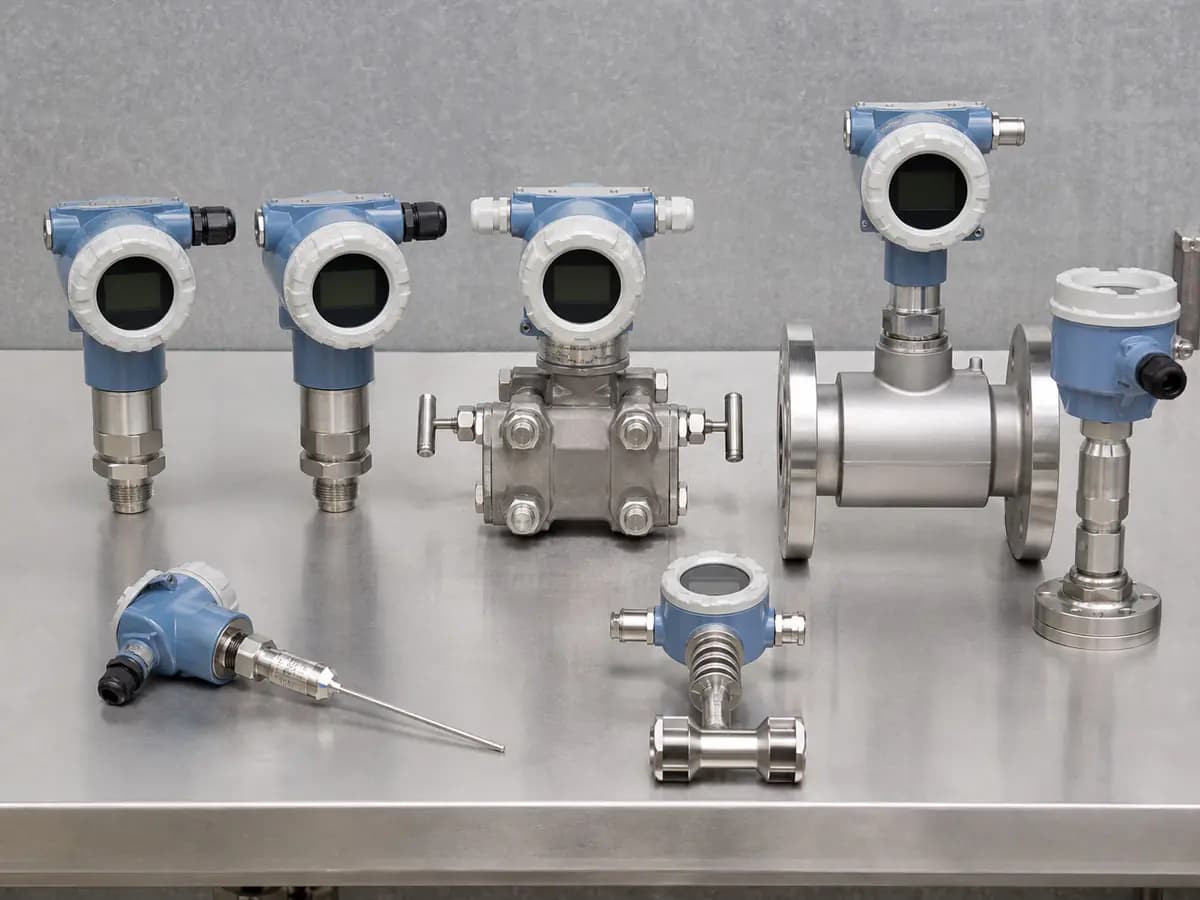
The retained image illustrates process instrumentation as a category; it does not identify the quoted FDWB variant.
RFQ checklist for a temperature point
- Identify whether the line item is a complete transmitter assembly or a replacement sensing element.
- Give normal temperature, excursions, required calibrated endpoints and the accepted measurement uncertainty.
- Attach the probe and thermowell drawing, including insertion length, outside diameter, connection and wetted material.
- Specify the required analog input or digital interface and the available supply at the instrument terminals.
- Request the selected sensor designation, wiring diagram and calibration record; ask the supplier to resolve any conflict between the web reference and the proposed datasheet.
- List any hazardous-area approval required by the installation, with model and certificate-scope verification before acceptance.
For an existing installation, include the old instrument's full model code. The generic FDWB designation is not enough to confirm a replacement.
Technical reference trail
These public references support the equipment family and selection context. They do not imply dealership, authorization or a guaranteed order specification.
Frequently Asked Questions
Does the FDWB family name identify one temperature range?
No. The manufacturer publishes separate integrated and compact versions. The integrated table distinguishes resistance sensing from thermocouple sensing, while the compact table specifies a narrower interval. Ask for the complete configuration and calibrated endpoints.
Can a bare RTD be ordered using only the transmitter specifications?
Specify the sensing element separately from the transmitter electronics. Request its designation, wiring and mechanical drawing; the reference pages do not establish interchangeability with the existing assembly.
What electrical and installation options are documented for the compact version?
Its page lists 4-20 mA DC and 1-5 V DC outputs, HART and RS485 options, SS304 or SS316 probe material, and fixed-thread installation. The exact interface and thread dimensions need confirmation for the selected order.
Submit RFQ for Temperature Transmitters, Thermocouples and RTDs
Send product, quantity, specification and destination details so the requirements can be reviewed with potential suppliers.
Technical and RFQ References
Check common units, standards and purchasing terminology, then build a structured request for this equipment.
Related Products
Oil and Gas Pressure Transmitters
Pressure transmitters for wellheads, process skids and production facilities, with published reference ranges from 5 kPa to 260 MPa and selectable analog or digital outputs.
Differential Pressure Transmitters
Differential pressure transmitters for flow, filter, vessel and level measurement. The cited FD3051S DP family spans 50 Pa to 3 MPa differential; static-pressure options are separate.
Process Level Transmitters
Process level transmitter selection using the FD86T pressure-guided example. Keep water-head range, operating temperature, enclosure protection and electrical interface distinct when preparing a tank or vessel RFQ.
Oilfield Flow Meters
Oilfield Flow Meters for wellsite, production-facility and process-skid pressure, differential pressure, temperature, flow and level measurement, with quotation fields for measured variable, calibrated range, accuracy, process connection, wetted materials, temperature, output protocol, power supply, enclosure rating and hazardous-area certification required by the project.
Related Technical Articles
How to Specify Temperature Transmitters, Thermocouples and RTDs for an Oilfield RFQ
Separate sensor type, calibrated span, probe and thermowell construction, transmitter output and hazardous-area requirements before quotation.
How to Specify Differential Pressure Transmitters for an Oilfield RFQ
Define low- and high-side pressure, differential span, static pressure, manifold arrangement, output and impulse-line conditions before quotation.
How to Specify Pressure Transmitters for an Oilfield RFQ
Compare calibrated range, accuracy, output, process connection, wetted materials and installation conditions before requesting a pressure-transmitter quotation.