Selection & Specification
Moulded FRP Grating: Select the Load Path, Mesh and Resin Together
View the model-specific values, conditions and sources
A panel dimension is only one part of the purchase
Two FRP grating offers can show similar mesh dimensions while answering different structural or environmental questions. A buyer needs a defined panel arrangement, its support conditions and the proposed resin basis before treating the quotations as comparable. Asking for a thicker panel is not a substitute for resolving those relationships.
Organize the enquiry by panel location, not merely by total grating area. Give each location a drawing reference and a place to record openings, supports and exposure. This is a document-coordination method, not a structural calculation or installation instruction.
Preserve the published combinations
The Endura moulded-products table includes a 38 mm-height option with 38 x 38 mm mesh notation and 7/5 top/bottom rib notation. A separate 50 mm-height option uses 38 x 38 mm with 9/7 ribs. Another entry uses 30 mm height and 38 x 38 (19 x 19) mm notation with 7/5 ribs.
The rib unit is not explicitly stated, and the mesh notation does not establish a universal clear-opening definition. These are dimensional combinations, not named models, order codes or load classes. Keep each combination intact rather than combining a preferred mesh from one row with a height from another.
Create a panel-location review sheet
Use the sheet to connect the buyer's drawing with the bidder's response. Do not populate missing design requirements with catalogue dimensions.
| Review subject | Record for the panel location | Evidence to request for the offered panel |
|---|---|---|
| Supports | Layout, clear spans and bearing widths | Load/deflection information for that arrangement |
| Geometry | Panel outline, orientation, cut-outs and trimmed edges | Matching panel drawing and fixing positions |
| Loading | Distributed and concentrated loads and required deflection criterion | Basis tied to the proposed resin and geometry |
| Exposure | Chemicals, concentrations, cleaning and splash or immersion | Resin designation and supporting exposure information |
| Project requirements | Applicable fire, smoke, slip, electrical or offshore acceptance needs | The specifically requested test or acceptance documents |
A response that addresses one row cannot silently close another. For example, a corrosion-related product description does not answer the load/deflection question, and a dimensional drawing does not identify the resin's suitability for the stated exposure.
Work through an opening before comparing panel prices
Imagine a fictional walkway schedule in which the buyer's drawing includes a cut-out, but the supplier's quotation identifies only an unmodified panel size. The quoted mesh matches the enquiry, so a simple dimensional check would report agreement.
The unresolved question is the offered arrangement around the opening and its supports. Return the drawing reference and ask the bidder to identify the panel outline, trimmed edges, fixing positions and corresponding load/deflection basis. Do not estimate the remaining span from panel height or assume that the unmodified panel information applies unchanged.
This exercise does not decide whether the arrangement is adequate. It identifies why the current quotation cannot answer that question. The responsible designer's requirements and the supplier's configuration-specific documents remain necessary.
Connect resin selection to the actual exposure
“Corrosion-resistant” is too broad to complete the material line. Describe the chemicals and concentrations, whether exposure is splash or immersion, the cleaning practice and the temperature cycle. Ask which resin is offered and what evidence addresses that combination.
The manufacturer's oil-and-gas application page discusses maintenance platforms and supporting structures. It does not certify every resin and dimensional option for a particular platform. Similarly, the different temperature statements in the reference material should not be adopted as a universal design limit. Request resin- and load-specific confirmation.
Keep special project acceptance requirements explicit. A general request for “certified FRP” does not identify what is to be tested, which panel configuration is covered or which documents are required with delivery.
Use an exception list, not an assumed equivalence
When the bidder proposes another height, mesh or resin, record which drawing and exposure assumptions remain unchanged and which need review. Classify the response as a dimensional alternative, a material alternative or a support-arrangement change. This helps the buyer route the question to the right reviewer instead of accepting every substitution as a price-only variation.
Use the moulded FRP grating reference and RFQ Builder to send the panel schedule, support drawings, exposure description and required acceptance records.
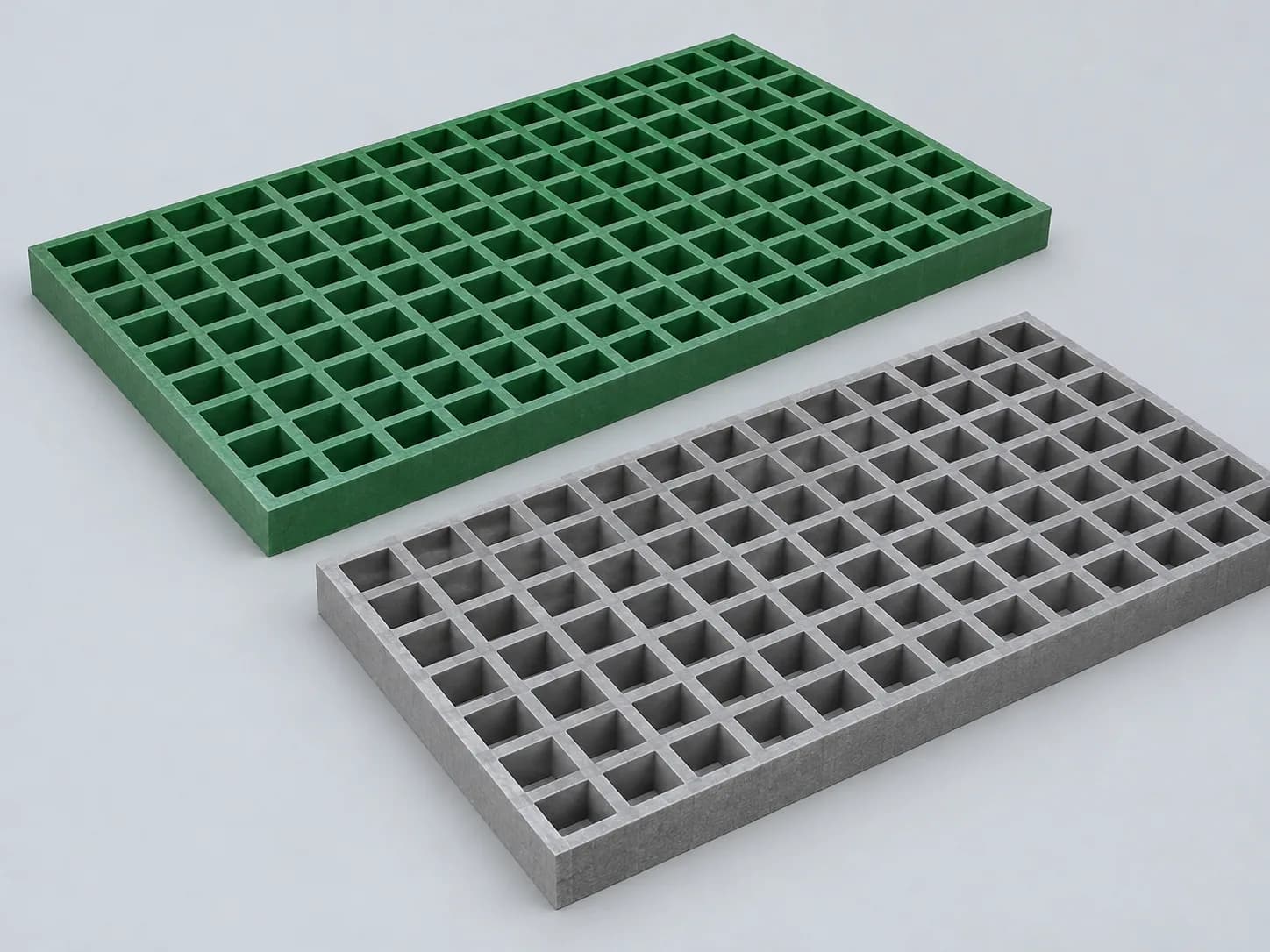
The AI-generated grating illustration does not verify resin, reinforcement, load capacity or fire classification. It is a category reference, not a photograph of the offered panel or evidence of stock.
Referenced model data
| Model | Parameter | Reference value | Conditions and source |
|---|---|---|---|
| Corrosion-resistant Moulded FRP Grating (family reference; no model code)Family catalogue reference | Material and manufacturing form | Glass-fibre yarn reinforcement with unsaturated resin, heat-cured in a mould | Manufacturer family description; resin chemistry/grade and fibre fraction not specified. Not interchangeable with pultruded or filament-wound products. Moulded products / product introductionChecked 2026-10-23 |
| Corrosion-resistant Moulded FRP Grating (family reference; no model code)Family catalogue reference | Moulded grating dimensional option | height: 38; mesh: 38 x 38; ribTop: 7; ribBottom: 5 height/mesh mm; rib unit not explicitly stated | Dimensional combination only, not a model or order code. The 38 x 38 mm mesh group includes the 38 mm height option with rib notation 7/5. The rib unit, resin, panel size, load/span basis and tolerances are not specified. Moulded product list / first 38 x 38 mesh group / height 38 rowChecked 2026-10-23 |
| Corrosion-resistant Moulded FRP Grating (family reference; no model code)Family catalogue reference | Alternative heavy-rib combination | height: 50; mesh: 38 x 38; ribTop: 9; ribBottom: 7 height/mesh mm; rib unit not explicitly stated | Separate heavier-rib row, not the 7/5 group. Not an identified model or rated load class. Rib thickness unit requires confirmation. Moulded product list / second image group / first height 50 rowChecked 2026-10-23 |
| Corrosion-resistant Moulded FRP Grating (family reference; no model code)Family catalogue reference | Fine-mesh combination | height: 30; mesh: 38×38 (19×19); ribTop: 7; ribBottom: 5 height/mesh mm; rib unit not explicitly stated | Source notation preserved without redefining clear opening/pitch. Dimensional option only, not a load rating or order code; no rib unit invented. Moulded product list / 38 x 38 (19 x 19) group / height 30 rowChecked 2026-10-23 |
| Corrosion-resistant Moulded FRP Grating (family reference; no model code)Family catalogue reference | Platform application statement | Manufacturer discusses maintenance platforms and customized supporting structures for oil/gas platforms | Company-level application statement only. Not proof that the dimensional grating option is class-approved for a specific platform. Oil and gas platform application articleChecked 2026-10-23 |
Authoritative references
- Moulded products and dimensional combinationschecked 2026-10-23
- Oil and gas platform applicationschecked 2026-10-23