Instrumentation & Automation
Dot-Peen Selection: A Representative-Part Traceability Trial
View the model-specific values, conditions and sources
A visible mark is not the whole acceptance result
A supplier can demonstrate a readable identifier without demonstrating the traceability workflow the buyer needs. The production requirement may also involve part access, fixture positioning, serial-number assignment, read-back and a record in another system. Buying the marking head alone leaves those responsibilities unresolved.
Define a representative-part trial before comparing a portable and a bench arrangement. The trial should connect the physical part, the intended symbol and the required data record. It is a proposed acceptance framework, not a qualified marking procedure or permission to indent a pressure-retaining component.
Use catalogue figures to identify questions
The SIC e-TOUCH EVO page identifies a portable marking window of 60 x 25 mm and describes text, logos and DataMatrix marking with optional supports. The window does not establish access to every part or guarantee a complete-code cycle time; optional supports must be identified in the offer.
The Huapu DBG-2-T1180 page lists a 110 x 80 mm marking area. Its speed of 1–3 characters per second is specifically associated with 4 x 4 mm characters. Its depth statement is no more than 0.3 mm and depends on material. Neither figure is an accepted depth on a particular component or a complete DataMatrix production-cycle guarantee.
Define the representative-part set
Ask the component owner to identify the permitted marking area and any integrity or depth restrictions. Provide the relevant part drawing or sample, material and hardness, surface condition, curvature, access and coating sequence. Specify the intended character or code size and which manufacturing steps precede or follow marking.
The part set should expose the actual selection questions rather than merely provide an easy demonstration surface. If the proposed fixture, support or reader is needed to address those questions, identify it as part of the trial configuration and quotation. Do not assume that a successful demonstration using different accessories represents the offered package.
Write an acceptance matrix with observable records
The following matrix proposes review subjects. The buyer and supplier must agree the actual acceptance rules; no code grade or process setting is supplied here.
| Trial subject | Question to resolve | Record to request |
|---|---|---|
| Part access and support | Can the offered arrangement reach the permitted location on the representative part? | Part identity, fixture and support configuration |
| Identifier content | Do fixed and variable fields match the requested record? | Requested data alongside the produced identifier |
| Read-back | Is reading or verification included, and against which rule? | Reader configuration and agreed result record |
| Duplicate handling | What happens when an identifier is already assigned? | Documented system response and disposition |
| Unreadable or failed mark | Who decides whether the part proceeds or needs action? | Exception record and responsibility |
| Data transfer | Does the receiving system obtain the intended record? | Interface mapping and agreed transaction evidence |
A machine that can mark text does not necessarily include a reader. SIC's traceability explanation describes combining marking, reading and a database, but that workflow is not a standard included feature of every marker. Huapu's interface description likewise does not establish plug-and-play compatibility with any particular MES.
Make the exception case part of the purchase discussion
Consider a fictional acceptance demonstration in which the mark is readable, but the database response is missing. The physical sample alone cannot show whether the identifier was recorded, whether a retry creates a duplicate or who owns the unresolved transaction.
Ask for the agreed handling of that state and the evidence that will be retained during acceptance. This is a question about the delivered workflow, not an instruction to continue production after an error. Keep component disposition with the responsible owner and distinguish equipment behaviour from the buyer's production rules.
A similar distinction applies to speed. A character-rate statement cannot answer a complete-cycle question that includes positioning, data exchange and read-back. Request the demonstration relevant to the agreed workflow without deriving a throughput guarantee from the catalogue.
Package the RFQ around the trial
Use the dot-peen marking-equipment reference and RFQ Builder to identify the machine, controller, supports, reader, software and integration work separately. Attach the representative-part requirements and acceptance matrix.
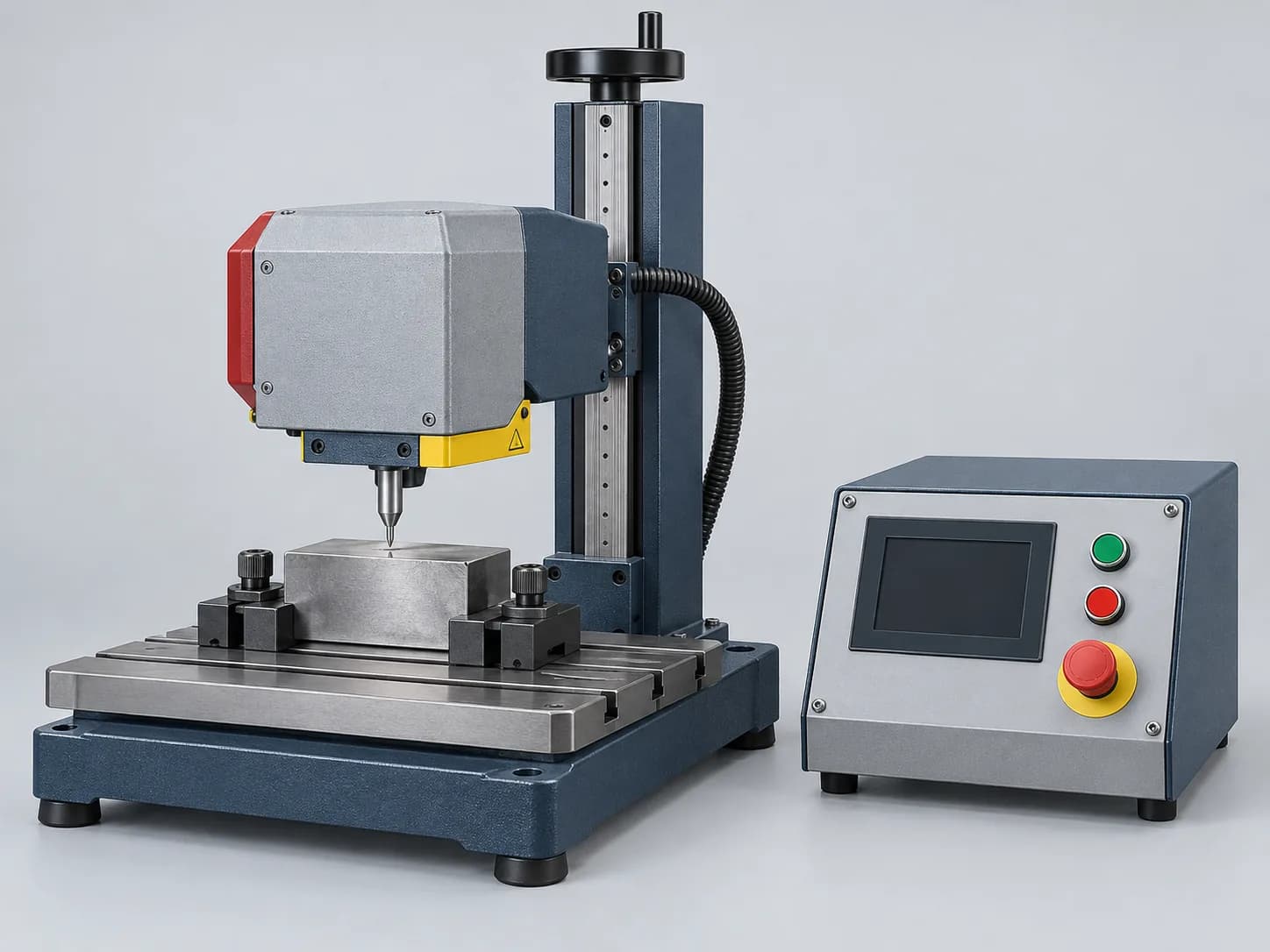
The AI-generated illustration shows a category-level marking arrangement, not verified mark quality, material suitability or the exact offered model. Catalogue capability does not establish a qualified procedure, inventory or manufacturer authorization.
Referenced model data
| Model | Parameter | Reference value | Conditions and source |
|---|---|---|---|
| e-TOUCH EVO | Marking window | 60 x 25 mm | Exact EVO product page and PDF file page5 agree; not older E-touch or E-TOUCH XL. No guaranteed depth/cycle rate inferred. Technical specifications > Marking windowChecked 2026-10-23 |
| e-TOUCH EVO | Stylus, formats and optional support | Tungsten-carbide stylus; text, logos and DataMatrix; optional front supports and column base | Options are not necessarily included; no code-grade, depth or part-integrity qualification is established. Description / AccessoriesChecked 2026-10-23 |
| DBG-2-T1180 | Standard marking area | 110 x 80 mm | Exact text in DBG-2-T series detail page; customization offered separately. Not a specification for every DBG-2-T variant. Technical parameters / standard marking areaChecked 2026-10-23 |
| DBG-2-T1180 | Marking speed | 1 to 3 characters/s | Only at stated4×4 mm character size. Not marks per second, not a complete code cycle time. Technical parameters / marking speedChecked 2026-10-23 |
| DBG-2-T1180 | Marking depth | <= 0.3 mm | Manufacturer explicitly says material-dependent. Not minimum assured depth and not an approved depth on a pressure-retaining oilfield component. Technical parameters / marking depthChecked 2026-10-23 |
| DBG-2-T1180 | Fixturing and data interfaces | Active fixture control; USB; database/serial marking; I/O and serial/network through a computer | Manufacturer functionality description; protocol, MES mapping and actual automation acceptance must be agreed. No universal plug-and-play compatibility. Performance features / DBG-2 controller / integration interfacesChecked 2026-10-23 |
| Dot-peen Part Traceability Marking Equipment (family reference; no model code)Family catalogue reference | Marking and reading workflow | Marking may be paired with a reading system and a database | SIC traceability-system explanation, not a standard included read/verify feature of every marker. Traceability implementation principleChecked 2026-10-23 |
Authoritative references
- e-TOUCH EVO product pagechecked 2026-10-23
- DBG-2-T1180 bench-top pneumatic dot-peen markerchecked 2026-10-23
- Marking, reading and database traceabilitychecked 2026-10-23