Selection & Specification
Centrifugal Mud Pump Selection: Head, Density and Shaft Power
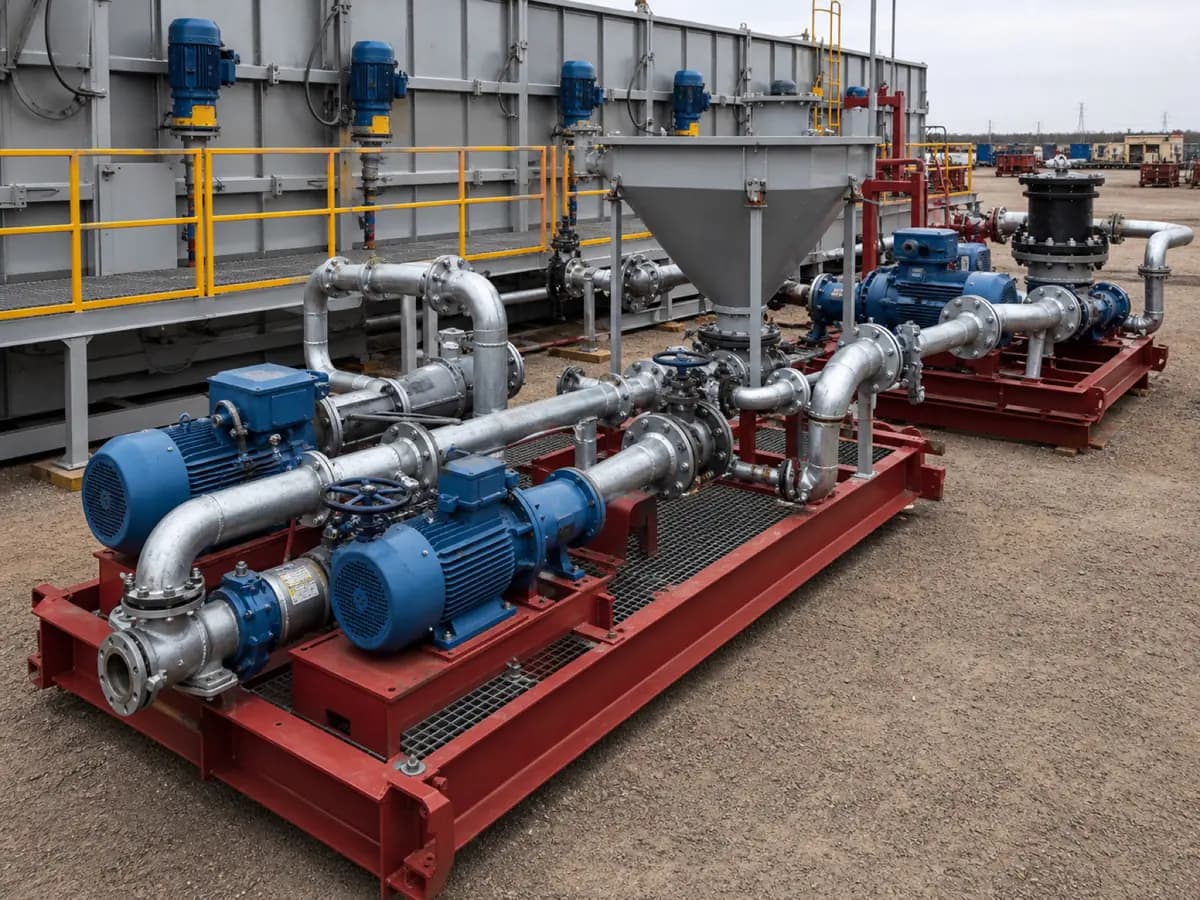
Start with a duty point, not the motor label
For a centrifugal mud pump, the purchasing question is whether the selected pump can deliver the required flow against the system head with the stated fluid. A motor rating or a pair of connection sizes cannot answer that question on its own.
The NOV Mission pump catalog, printed page 21, presents pump sizing in terms of flow, head, speed and fluid specific gravity. Use the centrifugal mud-pump reference for selected connection examples. The numbers below are a separate editorial calculation, not a catalog operating point or an offered package.
Worked example: every input is an assumption
Assume an incompressible fluid, a required flow of 180 m3/h, total dynamic head of 30 m and pump efficiency of 0.65. Compare a reference density of 1,000 kg/m3 with a higher assumed density of 1,400 kg/m3. Hold flow, head and efficiency constant solely to isolate the effect of density.
| Quantity | Reference-density case | Higher-density case |
|---|---|---|
| Flow | 180 m3/h = 0.05 m3/s | 180 m3/h = 0.05 m3/s |
| Total dynamic head | 30 m | 30 m |
| Assumed density | 1,000 kg/m3 | 1,400 kg/m3 |
| Assumed pump efficiency | 0.65 | 0.65 |
| Hydraulic power | 14.7 kW | 20.6 kW |
| Calculated pump shaft power | 22.6 kW | 31.7 kW |
Using g = 9.81 m/s2:
- Hydraulic power in kW = density x g x flow in m3/s x head / 1,000.
- Pump shaft power in kW = hydraulic power / pump efficiency.
- Higher-density case: 1,400 x 9.81 x 0.05 x 30 / 1,000 / 0.65 = 31.7 kW, rounded.
The KSB pump power definitions distinguish hydraulic output from input at the shaft and from electrical input to the complete drive. Efficiency must be a decimal in this calculation; substituting 65 for 0.65 would produce an unusable answer.
What the calculation does not select
This is not a motor selection. The 31.7 kW result is one assumed shaft duty, not a motor nameplate, starting requirement or electrical consumption. The actual operating range, drive losses, site conditions, service allowance and applicable motor requirements still need a supplier's selection.
Real mud can change efficiency and the pump/system curves. Do not take the equal-efficiency assumption as a prediction for a viscous, solids-laden or gas-containing fluid. Request the bidder's corrected duty and the basis of correction. Record the actual impeller diameter and speed on the selected curve.
Why head and pressure cannot be swapped without density
The pressure equivalent of 30 m of the higher-density fluid is 1,400 x 9.81 x 30 / 100,000 = 4.12 bar. At the reference density it is 2.94 bar. These are calculated head-to-pressure equivalents, not casing-pressure ratings.
Equating them directly to discharge-minus-suction gauge pressure also assumes that elevation and velocity-head differences between the measuring points are negligible. State the measuring locations and system boundary. Compare suction pressure, developed head and casing limits separately.
Check the suction side before accepting the duty
The KSB NPSH reference distinguishes available suction head supplied by the installation from the pump's requirement. They are not interchangeable entries on a quotation.
Ask for the pump's required NPSH at the selected flow, speed and impeller, and an installation calculation covering liquid level, suction losses, temperature and vapor-pressure assumptions. Have the supplier or responsible engineer confirm the applicable margin; this article does not assign a universal margin or treat equality as an acceptable design.
RFQ comparison and acceptance
Request a curve marked with minimum, normal and maximum duty, the fluid basis, efficiency, absorbed power, suction requirements and permitted operating range. Add the motor, seals, materials, piping interfaces, test conditions and a deviation list.
A useful bid review can then distinguish an interface mismatch from a hydraulic mismatch or an incomplete drive selection. If the request is actually for the high-pressure circulation pump, use the triplex pump reference instead; the centrifugal-duty example should not be applied to that different machine.
Authoritative references
- NOV Mission centrifugal pump catalog, sizing method on printed p.21checked 2026-10-13
- KSB Centrifugal Pump Lexicon: pump power and efficiency definitionschecked 2026-10-13
- KSB Centrifugal Pump Lexicon: NPSH available and requiredchecked 2026-10-13