Parts & Compatibility
Canned-Motor Pumps: Circulation Selection and Serial-Matched Parts
View the model-specific values, conditions and sources
Decide which purchase you are making
“Canned-motor pump replacement” can mean a complete process package, an installed pump assembly or individual wear components. Those requests need different starting documents. A complete-package inquiry begins with the process duty and supporting utilities. A spare-parts inquiry begins with the identity of the installed assembly. Combining the two can produce an attractive quotation that answers the wrong question.
Use two intake routes, then join them only where an actual interface must be resolved. Do not infer the required circulation arrangement from a brand name, and do not infer a replacement part number from a generic component description.
Route A: define the circulation responsibility
The TEIKOKU F/FA page distinguishes F without a connecting body from FA with one, within its stated particle-free, low-to-medium-temperature liquid service. The B-type page describes a different arrangement involving auxiliary-impeller circulation, an external heat exchanger and a thermal barrier.
These are configuration descriptions, not interchangeable selections or universal temperature limits. Their purchasing value is that they expose questions which a bare flow-and-head request would leave unanswered.
| Responsibility | Information to put in the enquiry | Response to obtain |
|---|---|---|
| Process liquid | Composition, temperature, viscosity and solids information | Selected configuration and stated limitations |
| Hydraulic duty | Required flow/head and suction conditions | Curve tied to the offered hydraulic unit, motor and impeller |
| Liquid circulation | Requested explanation of the selected liquid path | Configuration-specific description and interfaces |
| Supporting utilities | Utilities actually available at the site | Required utilities and supplier/buyer boundary |
| Protection and monitoring | Project requirements and responsibility allocation | Included instruments, protection scope and exclusions |
Treat an unanswered utility field as an open interface, not as zero consumption or evidence that no utility is required. This table requests documentation; it does not specify how to connect or operate a cooling circuit.
Route B: build a spare-part identity chain
The HERMETIC spare-parts enquiry page asks for item or part numbers, quantities and the HERMETIC serial number. Its CNP/CNPF/CNPK catalogue lists categories including wear rings, bearing sleeves, bearing bushes and slide rings. Those names describe components; they are not universal order codes.
Build the request around an identity chain: installed pump identity, applicable assembly record, required component and quantity. Keep a drawing position separate from an actual orderable part number. Where a record is incomplete, ask the supplier to identify the missing information rather than filling the field with a similar-looking part from another series.
A useful parts comparison has one line for the requested identity and another for the offered identity. If the supplier proposes a substitute or updated reference, request its documented relationship to the installed assembly. A matching category name cannot establish interchangeability.
Use a branching review instead of one generic checklist
Consider this fictional inquiry: a maintenance buyer sends a photograph of a bearing sleeve while a project buyer asks the same vendor for a complete replacement pump. The vendor returns one line described only as “canned-motor pump parts.”
The maintenance request remains open because the installed serial number and part reference are not connected to the offer. The project request remains open because the hydraulic, motor, circulation and utility boundaries are absent. Combining both requests into one larger order would not resolve either gap.
Split the response into a serial-matched parts line and a complete-package line. Compare each against its own input documents. This is a scope correction, not a conclusion that the photographed part is defective or that a different pump is required.
Read a design statement at its stated scope
The HERMETIC CNP catalogue describes design according to API 685. That manufacturer statement does not certify an offered assembly or establish that an API 610 selection can be substituted unchanged. Ask for the documents applicable to the actual configuration and project requirements; do not turn a standard reference into a compatibility claim.
Similarly, a family maximum cannot replace the selected curve. The useful closing record identifies the offered hydraulic/motor combination, circulation arrangement, utilities and acceptance documents together.
Prepare two clear RFQ lines
Use the sealless canned-motor pump reference alongside the RFQ Builder. Separate complete equipment from serial-matched spares and attach the corresponding duty or identification documents.
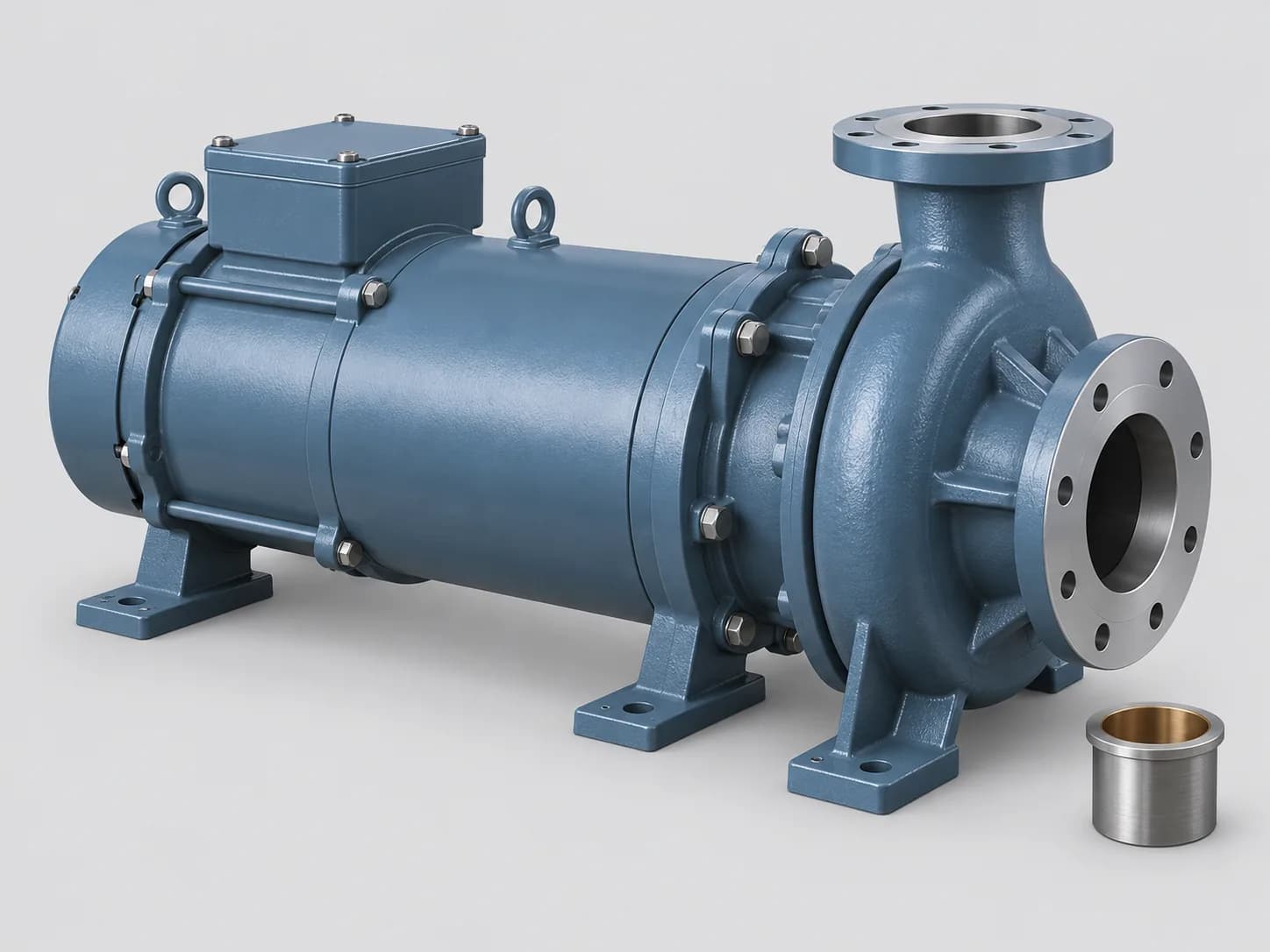
The image is an AI-generated category illustration, not an exact-model photograph; it does not demonstrate internal canned barriers or circulation paths. These purchasing checks establish neither part availability nor manufacturer authorization.
Referenced model data
| Model | Parameter | Reference value | Conditions and source |
|---|---|---|---|
| CNP / CNPF / CNPKFamily catalogue reference | published design reference | Design according to API 685 | Manufacturer design statement in the catalogue Model/design section; not independent certification or evidence of API 610 compliance. PDF p.3 / Model/designRevision Product information CNP-CNPF-CNPK / EN / 06 / 2022 · Checked 2026-10-23 |
| CNP / CNPF / CNPKFamily catalogue reference | catalogue part categories | wear ring; impeller wear ring; bearing sleeve; bearing bush; slide ring | The reduced parts list identifies component categories, not directly orderable part numbers applicable to every pump. PDF p.22 / Reduced part listRevision Product information CNP-CNPF-CNPK / EN / 06 / 2022 · Checked 2026-10-23 |
| HERMETIC installed pumpsFamily catalogue reference | spare parts identification | Item or part number, quantity and HERMETIC serial number | Manufacturer spare-parts identification fields; not evidence of interchangeability, availability or an accepted order. Place your order directlyRevision Web page has no controlled revision identified; retrieval time is not the issue date. · Checked 2026-10-23 |
| TEIKOKU F / FAFamily catalogue reference | connector variant | F without connecting body; FA with connecting body | Configuration depends on the pump/motor combination. The stated service is particle-free liquid at low to medium temperature. Separate maximum flow, head and power are not combined into one operating point. Product description / F and FA connecting-body configurationsRevision Web page has no controlled revision identified; retrieval time is not the issue date. · Checked 2026-10-23 |
| TEIKOKU BFamily catalogue reference | cooling arrangement | Auxiliary-impeller circulation, external heat exchanger and thermal barrier | B-type construction description only; no cooling-water duty or temperature limit for all canned-motor pumps is inferred. Product description / B-type cooling and thermal barrierRevision Web page has no controlled revision identified; retrieval time is not the issue date. · Checked 2026-10-23 |
Authoritative references
- HERMETIC Canned Motor Pumps Type CNP / CNPF / CNPKchecked 2026-10-23
- Enquire about spare parts for HERMETIC pumps | HERMETICMenuchecked 2026-10-23
- TEIKOKU Basic Type F / FA Canned-Motor Pumpschecked 2026-10-23
- TEIKOKU High-Temperature Separated Type B Canned-Motor Pumpschecked 2026-10-23