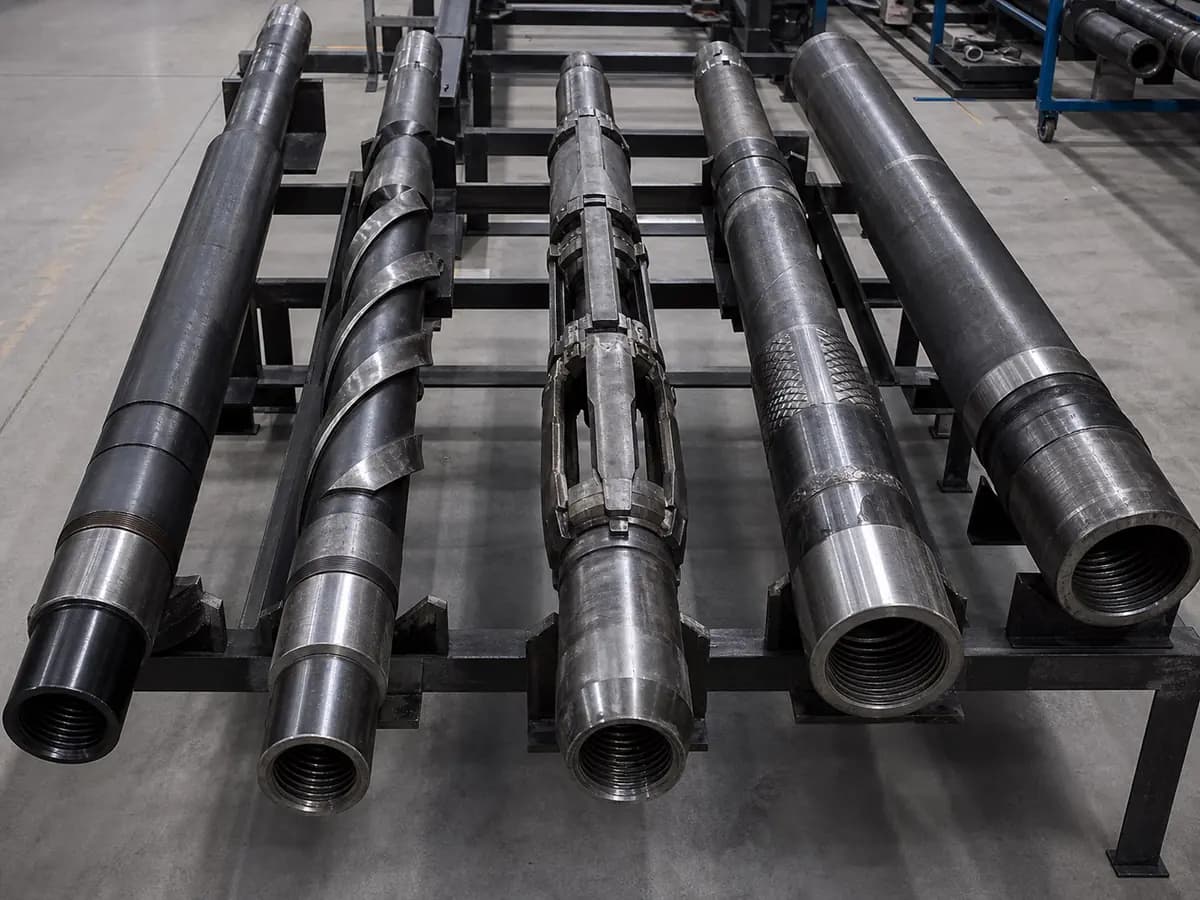
AI-generated category reference. It is not a photograph of a specific manufacturer or exact product model.
Drilling & Downhole Tools
Drilling Jars and Shock Tools
Hydraulic drilling-jar and accelerator references that distinguish tool dimensions, tensile limits and jarring direction, using QY165 III, SS172 and SZJQ95 examples.
- Documented model references
- QY165 III · SS172 · SZJQ95
- Parameters, conditions and sources
Source-bound technical references
Reference fields for quotation comparison. Final values must be confirmed in the signed manufacturer datasheet.
| Model | Parameter | Reference value | Conditions and source |
|---|---|---|---|
| QY165 III | Tool outside diameter | 165 mm | QY165 III row only; corresponding connection is NC50. A shared outside diameter does not establish cross-brand compatibility. Specifications; QY165 III / Tool ODRevision Public product page; controlled revision not stated · Checked 2026-10-23 |
| QY165 III | Tool inside diameter | 57 mm | QY165 III row only. Pass-through requirements and connection drawing remain separate from this bore reference. Specifications; QY165 III / IDRevision Public product page; controlled revision not stated · Checked 2026-10-23 |
| QY165 III | Allowable working tensile | 2000 kN | Published allowable working tensile, not yield, breaking load or jarring force. Temperature derating and fatigue basis are unspecified. Specifications; QY165 III / Allowable Working TensileRevision Public product page; controlled revision not stated · Checked 2026-10-23 |
| QY165 III | Maximum up-jarring force | 700 kN | Exact model row; not surface overpull or an operating instruction. Configuration and approved operation conditions require manufacturer confirmation. Specifications; QY165 III / Max Up JarringRevision Public product page; controlled revision not stated · Checked 2026-10-23 |
| QY165 III | Maximum down-jarring force | 350 kN | Exact model row; not interchangeable with allowable working tensile or a field setting. Specifications; QY165 III / Max Down JarringRevision Public product page; controlled revision not stated · Checked 2026-10-23 |
| SS172 | Tool outside diameter | 172 mm | SS172 up-jarring-only model; not a double-acting QY model. Connection drawing and operating requirements remain separate. Specifications; SS172 / Tool ODRevision Public product page; controlled revision not stated · Checked 2026-10-23 |
| SS172 | Allowable working tensile | 2000 kN | SS172 allowable working tensile; not maximum up-jarring force, yield strength or a surface operating load. Specifications; SS172 / Allowable Working TensileRevision Public product page; controlled revision not stated · Checked 2026-10-23 |
| SZJQ95 | Maximum working load | 600 kN | Accelerator reference, not a standalone jar. Use with a compatible hydraulic jar; the separate yield-tension row is not this working-load limit. Specifications; SZJQ95 / Max Working LoadRevision Public product page; controlled revision not stated · Checked 2026-10-23 |
Technical selection notes
QY165 III and SS172 values remain tied to their own rows. Only the SZJQ95 accelerator working-load field is adopted; merged cells in other accelerator rows are not treated as repeated pressure ratings. No downhole operating sequence is prescribed.
Published manufacturer data is a selection reference, not a quotation or evidence of supply availability.
Product overview
Jar, accelerator and shock tool are not synonyms
A drilling jar and an accelerator perform different functions within a planned downhole assembly. An accelerator is used with a compatible jar, not as a standalone substitute. A shock tool has a separate duty and should not be selected from a jar's headline load.
Gaofeng's references include a QY165 III jar, an SS172 up-jarring tool and an SZJQ95 accelerator. These are separate model examples, not an approved combined bottom-hole assembly. Their shared appearance or overlapping dimensions does not establish system compatibility.
Read the column label before the number
The QY165 III row distinguishes allowable working tensile from maximum up- and down-jarring force. Those are not alternative ways to express one load capacity. In particular, a catalogue jarring-force value is not a surface overpull instruction.
| Reference field | Keep separate from |
|---|---|
| Allowable working tensile | Yield tension, breaking strength and impact force |
| Maximum up/down jarring | Surface operating load and a universal downhole impact result |
| Outside diameter and bore | Connection compatibility and complete assembly clearance |
| Accelerator working load | Jar force rating or a claimed force multiplier |
The source does not supply a complete temperature, fatigue and operating-condition envelope for these values. A responsible tool specialist must select and approve the actual assembly and procedure.
Direction and connection matter
The SS page describes up-jarring only. Do not infer bidirectional operation because another hydraulic jar in the same catalogue supports both directions. Likewise, the QY165 III and nearby QY159 III rows must not exchange connection designations just because several load values match.
Request the full connection identification and drawing, not only an abbreviated connection label. For used or serviced tools, identification, service history and current inspection records are separate from the original catalogue.
RFQ scope and acceptance
State whether the purchase is a complete tool, service parts or a replacement assembly. Provide the approved tool requirements, connection interfaces, dimensional restrictions, service environment and required inspection documentation. Keep any proposed accelerator as a separate line item with its compatibility assessment.
For a replacement, use the nameplate and parts identification guide. This reference supports document comparison; it is not a jarring calculation, tool-position recommendation or operational instruction.
Technical reference trail
These public references support the equipment family and selection context. They do not imply dealership, authorization or a guaranteed order specification.
Frequently Asked Questions
Is allowable working tensile the same as jarring force?
No. The manufacturer's table uses separate columns. Neither should be translated directly into surface operating instructions without the approved tool procedure.
Can an accelerator replace a jar?
The referenced accelerator is described as a companion to a hydraulic jar. It is not a standalone substitute, and no universal force multiplier is established.
Submit RFQ for Drilling Jars and Shock Tools
Send product, quantity, specification and destination details so the requirements can be reviewed with potential suppliers.
Technical and RFQ References
Check common units, standards and purchasing terminology, then build a structured request for this equipment.
Related Products
Drilling Tools and BHA Components
Drilling Tools and BHA Components for drillstring assembly, directional drilling, impact release, hole conditioning and fishing operations, with quotation fields for tool type, outside diameter, inside diameter, connection, fishing-neck size, tensile/torsional requirement, operating environment and requested inspection documents.
Custom Downhole Tools
Custom Downhole Tools for drillstring assembly, directional drilling, impact release, hole conditioning and fishing operations, with quotation fields for tool type, outside diameter, inside diameter, connection, fishing-neck size, tensile/torsional requirement, operating environment and requested inspection documents.
Oilfield Fishing Tools
Oilfield Fishing Tools for drillstring assembly, directional drilling, impact release, hole conditioning and fishing operations, with quotation fields for tool type, outside diameter, inside diameter, connection, fishing-neck size, tensile/torsional requirement, operating environment and requested inspection documents.
Drill Collars and Heavy-Weight Drill Pipe
Drill Collars and Heavy-Weight Drill Pipe for drillstring assembly, directional drilling, impact release, hole conditioning and fishing operations, with quotation fields for tool type, outside diameter, inside diameter, connection, fishing-neck size, tensile/torsional requirement, operating environment and requested inspection documents.
Related Technical Articles
Drilling Tools Supplier Selection Guide
A compact guide to sourcing drilling stabilizers, drilling jars, drill collars, subs, reamers, and downhole tools.
Drilling Jar Review: Tensile Rating and Jarring Force Are Different Fields
A fictional bid-table repair shows why a jar's working tensile reference cannot stand in for jarring force, surface overpull or an operating instruction.
How to Identify Oilfield Spare Parts from Nameplates and Photos
A field-ready photo and measurement checklist for requesting mud pump, rig, BOP and other oilfield replacement parts.